
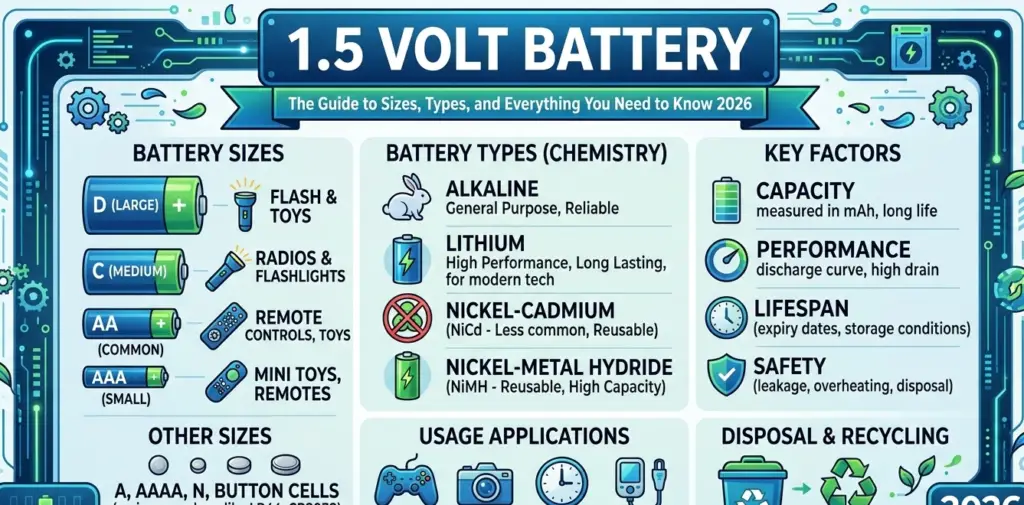
If you have ever opened a battery compartment and seen a tiny label that reads 1.5V — and wondered what that actually means, what size battery you need, or what the difference is between all the options at the store — this is the only guide you will ever need.
Whether you are replacing batteries in a TV remote, a wall clock, a hearing aid, a camera, a flashlight, or a children’s toy — understanding the 1.5 volt battery will save you time, money, and the frustration of buying the wrong thing. In this complete guide we cover everything: what a 1.5 volt battery is, all the different sizes, what they look like, the difference between alkaline and lithium ion versions, and exactly which one you need for your specific device.
What Is a 1.5 Volt Battery?
The most fundamental question first: what is a 1.5 volt battery?
A 1.5 volt battery is a single-cell electrochemical power source that produces a nominal output voltage of 1.5 volts. The number 1.5 refers to the electrical potential difference — measured in volts — between the positive terminal (the bump end) and the negative terminal (the flat end) of the battery.
This 1.5 volt standard has been the foundation of portable battery power for over a century. It is the most common battery voltage in the world and is used in an enormous range of everyday devices from television remotes and flashlights to clocks, radios, toys, cameras, and medical devices.
When a device requires multiple batteries — for example, a flashlight that takes two AA batteries — those batteries are typically connected in series, meaning their voltages add together. Two 1.5 volt batteries connected in series produce 3 volts. Four produce 6 volts. This is why battery compartments specify both the number and type of batteries required.
The Chemistry Behind 1.5 Volts
The 1.5 volt output is not an arbitrary number — it is determined by the chemistry inside the battery. Different chemical combinations produce different natural voltage levels. The most common chemistry used in 1.5 volt batteries is alkaline, which uses zinc and manganese dioxide to produce its characteristic 1.5V output. Carbon-zinc batteries also produce 1.5 volts but with lower capacity and shorter lifespan.
The 1.5 volt standard became universal because it represents the natural output of these electrochemical reactions — not because engineers chose it arbitrarily. This is why so many devices around the world are designed around this voltage.
What Are 1.5 Volt Batteries Used For?
Before diving into sizes and types, it helps to understand the full range of devices that use 1.5 volt batteries — because this directly affects which size and type you should choose.
Household Remote Controls — Television remotes, air conditioning remotes, and entertainment system remotes almost universally use AA or AAA 1.5 volt batteries.
Wall Clocks and Alarm Clocks — Most battery-powered clocks use a single AA or C cell 1.5 volt battery.
Flashlights and Torches — Depending on size, flashlights use AA, AAA, C, or D cell 1.5 volt batteries.
Children’s Toys — The majority of battery-powered toys use AA or AAA 1.5 volt batteries, often requiring four to six at a time.
Cameras and Photography Equipment — Many film cameras and some digital accessories use AA 1.5 volt batteries.
Hearing Aids — Hearing aids rely on tiny 1.5 volt button cell batteries, typically zinc-air chemistry in sizes 10, 13, 312, or 675.
Medical Devices — Blood glucose meters, blood pressure monitors, and other medical devices commonly use AA or AAA 1.5 volt batteries.
Computer Peripherals — Wireless keyboards, computer mice, and game controllers typically use AA or AAA 1.5 volt batteries.
Smoke Detectors — Many smoke detectors use a single 9-volt battery but a significant number use AA 1.5 volt batteries.
Calculators and Small Electronics — Calculators, small radios, and similar devices often use AAA or button cell 1.5 volt batteries.
What Does a 1.5 Volt Battery Look Like?
One of the most common questions people ask is: what does a 1.5 volt battery look like?
The honest answer is that 1.5 volt batteries come in many shapes and sizes — so there is no single appearance that defines all of them. However, they all share a few universal features:
The Positive Terminal — All 1.5 volt cylindrical batteries have a small raised bump on one end. This is the positive terminal marked with a + symbol. It is always the end you insert first against the spring in most battery compartments.
The Negative Terminal — The opposite flat end is the negative terminal, marked with a — symbol. In most battery compartments this end faces the spring contact.
The Outer Casing — Most 1.5 volt batteries have a metallic outer shell wrapped in a printed label that shows the battery type (AA, AAA, C, D), the brand name, the voltage (1.5V), and other specifications.
The Color Coding — Major battery brands use consistent color coding. Energizer uses gold and black. Duracell uses copper and black. Panasonic uses green and white. These colors help you quickly identify battery type and brand at a glance.
For button cell batteries, the appearance is entirely different — they look like small, flat metal coins or discs, which is why they are sometimes called coin cell batteries. These are much smaller than cylindrical batteries and are used in compact devices.
1.5 Volt Battery Sizes — The Complete Guide
This is where most confusion happens. What size is a 1.5 volt battery? The answer is that 1.5 volt batteries come in multiple standardized sizes. Here is every size you need to know:
AA Battery (LR6)
The AA battery is the most popular battery size in the world. It is also called a double-A or LR6 battery.
Dimensions: 14.5mm diameter × 50.5mm length Weight: Approximately 23 grams Appearance: Medium cylindrical battery — roughly the size of a human finger Capacity: Typically 2,000 to 3,000 mAh for alkaline versions Common Uses: TV remotes, flashlights, toys, cameras, wireless keyboards, wall clocks, smoke detectors, portable radios
The AA is the battery most people picture when they hear the words “battery” — it is the universal standard of the consumer battery world.
AAA Battery (LR03)
The AAA battery is the second most common battery size. It is also called a triple-A or LR03 battery.
Dimensions: 10.5mm diameter × 44.5mm length Weight: Approximately 11.5 grams Appearance: Slimmer and shorter than the AA — noticeably smaller Capacity: Typically 1,000 to 1,200 mAh for alkaline versions Common Uses: Slim TV remotes, digital thermometers, small flashlights, electric toothbrushes, hearing aid accessories, computer mice, small toys
The AAA is essentially a slimmer, lower-capacity version of the AA. It exists to fit into smaller, lighter devices where the AA would be too large or too heavy.
C Battery (LR14)
The C battery is a medium-large cylindrical battery less commonly seen in modern devices but still used in specific applications.
Dimensions: 26.2mm diameter × 50mm length Weight: Approximately 67 grams Appearance: Significantly larger and wider than the AA — about the size of a small soda can in proportions Capacity: Typically 7,000 to 8,000 mAh for alkaline versions Common Uses: Medium-sized flashlights, portable radios, musical instruments, baby monitors, some lanterns
The C battery offers significantly higher capacity than AA or AAA, making it suitable for devices that need to run for long periods without battery replacement.
D Battery (LR20)
The D battery is the largest standard cylindrical 1.5 volt battery.
Dimensions: 34.2mm diameter × 61.5mm length Weight: Approximately 135 grams Appearance: Large, thick cylindrical battery — the biggest standard battery most people will encounter Capacity: Typically 12,000 to 18,000 mAh for alkaline versions Common Uses: Large flashlights, portable lanterns, boom boxes, large portable radios, emergency equipment, high-drain devices requiring long battery life
The D battery’s enormous capacity makes it the choice for high-drain devices or devices that need to operate for very long periods between battery changes.
N Battery (LR1)
The N battery is a small cylindrical battery less commonly known but still used in specific devices.
Dimensions: 12mm diameter × 30.2mm length Weight: Approximately 9 grams Appearance: Smaller than AAA, similar profile but shorter Capacity: Typically 800 to 1,000 mAh Common Uses: Some older telephone handsets, certain medical devices, some security systems, laser pointers
1.5 Volt Button Cell Batteries
Button cell batteries — also called coin cell batteries — are flat, disc-shaped 1.5 volt batteries used in compact devices where cylindrical batteries would be too large.
Appearance: Flat metal discs ranging from about 5mm to 25mm in diameter and 1mm to 6mm in thickness — they genuinely look like small metal coins or buttons.
Common 1.5 Volt Button Cell Sizes:
LR44 (AG13) — One of the most common button cells. 11.6mm diameter × 5.4mm height. Used in watches, small calculators, laser pointers, key fobs, and small toys.
LR41 (AG3) — Smaller than LR44. 7.9mm diameter × 3.6mm height. Used in small watches, medical thermometers, and compact electronics.
LR43 (AG12) — 11.6mm diameter × 4.2mm height. Used in calculators, watches, and small electronic devices.
LR54 (AG10) — 11.6mm diameter × 3.05mm height. Used in thin watches and compact calculators.
LR626 (AG4) — 6.8mm diameter × 2.6mm height. Used in small watches and miniature electronics.
These button cells all produce 1.5 volts but differ in physical size and capacity, making them suitable for different compact devices.
1.5 Volt Alkaline Button Cell Battery
The 1.5 volt alkaline button cell battery deserves special mention because it is often confused with other button cell chemistries.
The key point is that not all button cells produce 1.5 volts. Silver oxide button cells also produce 1.55 volts (very close to 1.5V and often interchangeable). Lithium coin cells typically produce 3 volts — completely different and not interchangeable with 1.5 volt devices. Zinc-air button cells (used in hearing aids) produce 1.4 volts.
When you specifically need a 1.5 volt alkaline button cell battery, look for the LR designation in the size code — LR44, LR41, LR43, and so on. The LR prefix indicates alkaline chemistry producing the standard 1.5 volt output. The SR prefix indicates silver oxide chemistry (1.55V). The CR prefix indicates lithium chemistry (3V).
1.5 Volt Li-Ion Battery — The New Generation
The 1.5 volt li-ion battery is one of the most interesting developments in consumer battery technology in recent years and deserves detailed explanation.
Traditional lithium-ion batteries produce 3.6 to 3.7 volts — far higher than the 1.5 volt standard used by most consumer devices. This meant that until recently, lithium-ion technology could not be used as a direct drop-in replacement for standard AA, AAA, and other 1.5 volt batteries.
The breakthrough came with the development of 1.5V lithium-ion AA and AAA batteries — these batteries include a built-in DC-to-DC converter circuit inside the battery itself that steps down the natural 3.7 volt lithium-ion output to a regulated, stable 1.5 volts. The result is a rechargeable lithium-ion battery in the standard AA or AAA form factor that outputs exactly 1.5 volts — perfectly compatible with all devices designed for standard 1.5 volt batteries.
Advantages of 1.5 Volt Li-Ion Batteries
Regulated Voltage Output — Unlike alkaline batteries that gradually drop from 1.5V to under 1.0V as they discharge, 1.5V lithium-ion batteries maintain a stable 1.5 volt output for almost their entire discharge cycle. This is a significant advantage for devices sensitive to voltage drop — cameras, wireless devices, and high-drain electronics in particular.
Rechargeable — 1.5V lithium-ion batteries can be recharged hundreds of times, making them far more economical and environmentally friendly than disposable alkaline batteries over the long term.
USB Charging — Most 1.5V lithium-ion AA and AAA batteries come with built-in USB-C or micro-USB charging ports on the battery itself — no separate charger required. Simply connect a USB cable directly to the battery to recharge.
High Energy Density — Lithium-ion chemistry stores more energy per gram than alkaline chemistry. 1.5V li-ion AA batteries typically offer 2,500 to 3,500 mAh capacity — comparable to or exceeding premium alkaline batteries.
Long Shelf Life — Lithium-ion batteries have very low self-discharge rates. A 1.5V li-ion battery stored unused will retain most of its charge for several years.
Lightweight — Lithium-ion chemistry is lighter than the zinc-manganese dioxide chemistry in alkaline batteries, which matters in portable devices where weight is important.
Disadvantages of 1.5 Volt Li-Ion Batteries
Higher Initial Cost — A set of 1.5V li-ion batteries costs significantly more upfront than alkaline batteries. The cost is recovered over time through recharging rather than replacing, but the initial investment is higher.
Requires Charging Infrastructure — Unlike disposable alkaline batteries that can be purchased anywhere and used immediately, 1.5V li-ion batteries require a USB power source for recharging.
Not Available in All Sizes — Currently, 1.5V li-ion batteries are commercially available mainly in AA and AAA sizes. C, D, and button cell equivalents are less common or not yet widely available.
Electronics Inside Can Fail — The voltage regulation circuit inside the battery adds a component that can potentially fail, unlike the simple electrochemical reaction of an alkaline battery.
What Battery Is 1.5 Volts? — Quick Reference
If you are standing in a store or searching online and asking what battery is 1.5 volts, here is your complete quick reference answer:
All of the following are 1.5 volt batteries: AA (LR6), AAA (LR03), C (LR14), D (LR20), N (LR1), LR44 button cell, LR41 button cell, LR43 button cell, LR54 button cell, LR626 button cell, and 1.5V li-ion rechargeable AA and AAA batteries.
All standard alkaline batteries in these sizes produce 1.5 volts. Carbon-zinc batteries in the same sizes also produce 1.5 volts but with lower capacity. Silver oxide button cells produce 1.55 volts — close enough to be compatible with most 1.5V devices.
What is NOT a 1.5 volt battery: 9V batteries (9 volts), CR2032 and other CR coin cells (3 volts), 18650 lithium-ion cells (3.6-3.7 volts), and rechargeable NiMH batteries in AA/AAA sizes (1.2 volts — lower than 1.5V and not always compatible with all devices).
Alkaline vs Lithium Ion vs Carbon Zinc — Which 1.5 Volt Battery Should You Choose?
With several chemistry options available, choosing the right 1.5 volt battery for your specific use case matters for both performance and cost efficiency.
Choose Alkaline When: You need a reliable, affordable, widely available battery for moderate-drain everyday devices like remotes, clocks, and radios. Alkaline batteries are available everywhere, cost relatively little, and perform well across a wide temperature range. For devices you use occasionally, alkaline is almost always the right choice.
Choose 1.5V Lithium-Ion When: You use high-drain devices frequently — gaming controllers, wireless mice, digital cameras, powerful flashlights. The stable voltage output and rechargeability make li-ion AA and AAA batteries the most economical choice over the long term for frequently used, high-drain devices. If you go through multiple sets of AA or AAA batteries every month, switching to rechargeable 1.5V li-ion will save significant money within three to six months.
Choose Carbon-Zinc When: You need inexpensive batteries for very low-drain devices used rarely — a clock in a spare room, a rarely-used remote, an emergency flashlight kept in a drawer. Carbon-zinc batteries are the cheapest option but have lower capacity and shorter shelf life than alkaline.
Choose Silver Oxide Button Cells When: Your device — typically a watch or precision instrument — specifically requires silver oxide chemistry for stable voltage output over the full discharge cycle. The 1.55 volt output is close enough to 1.5 volts to be compatible with almost all devices, and silver oxide chemistry provides better long-term stability than alkaline in button cell sizes.
How to Read 1.5 Volt Battery Labels and Codes
Understanding the codes on battery labels helps you always buy exactly what you need:
IEC Code — The international standard code. LR6 = AA alkaline. LR03 = AAA alkaline. LR14 = C alkaline. LR20 = D alkaline. The L indicates alkaline chemistry. The R indicates round (cylindrical). The number indicates the specific size.
ANSI Code — The American standard. 15A = AA. 24A = AAA. 14A = C. 13A = D.
Voltage Marking — Always shown as 1.5V on the label for standard alkaline batteries.
Expiry Date — All quality alkaline batteries show a use-by date, typically 5 to 10 years from manufacture. Always check this when buying.
mAh Rating — Some batteries show their capacity in milliampere-hours. Higher mAh means more energy stored and longer runtime.
Frequently Asked Questions — 1.5 Volt Battery
What is a 1.5 volt battery? A 1.5 volt battery is a single-cell battery that produces 1.5 volts of electrical potential. It is the most common battery voltage in the world and powers millions of everyday devices including remotes, clocks, toys, flashlights, and cameras. Common 1.5V battery sizes include AA, AAA, C, D, and various button cell sizes.
What are 1.5 volt batteries? 1.5 volt batteries are a family of single-cell batteries that all share the same nominal output voltage of 1.5 volts. They come in multiple sizes and chemistries — alkaline, carbon-zinc, and lithium-ion — but all produce the same 1.5 volt output that the vast majority of battery-powered consumer devices are designed to use.
What does a 1.5 volt battery look like? Cylindrical 1.5 volt batteries (AA, AAA, C, D) look like metal cylinders with a raised bump on one end (positive terminal) and a flat surface on the other (negative terminal), wrapped in a printed label. Button cell 1.5 volt batteries (LR44, LR41, etc.) look like small flat metal coins or discs. The exact size varies — from the large D cell (about 6cm long) to tiny button cells just a few millimeters thick.
What size is a 1.5 volt battery? 1.5 volt batteries come in many standardized sizes. The most common are AA (14.5mm × 50.5mm), AAA (10.5mm × 44.5mm), C (26.2mm × 50mm), and D (34.2mm × 61.5mm). Button cell sizes range from tiny 6mm diameter coins to larger 20mm diameter discs. The size you need depends entirely on what your specific device requires.
What battery is 1.5 volts? All standard AA, AAA, C, D, and N alkaline batteries are 1.5 volts. Alkaline button cells including LR44, LR41, LR43, and LR54 are also 1.5 volts. The new generation of rechargeable 1.5V lithium-ion AA and AAA batteries are also 1.5 volts. These are the most common 1.5 volt battery options available today.
What is a 1.5 volt li-ion battery? A 1.5 volt li-ion battery is a rechargeable lithium-ion battery in standard AA or AAA size that includes a built-in voltage regulation circuit to output exactly 1.5 volts — matching the standard alkaline voltage while offering the advantages of rechargeable lithium-ion technology including stable voltage output, USB charging, and hundreds of recharge cycles.
What is a 1.5 volt alkaline button cell battery? A 1.5 volt alkaline button cell battery is a small flat disc-shaped battery using alkaline chemistry (zinc-manganese dioxide) to produce 1.5 volts. Common sizes include LR44, LR41, LR43, LR54, and LR626. They are used in watches, calculators, laser pointers, key fobs, hearing aids, and other compact devices. They are identified by the LR prefix in their size code, which indicates alkaline chemistry.
Can I replace a 1.5 volt battery with a rechargeable NiMH battery? Rechargeable NiMH batteries in AA and AAA sizes produce 1.2 volts — not 1.5 volts. Most devices work fine with 1.2V NiMH batteries because the difference is small, but some devices — particularly those with low-battery detection circuits or those requiring full 1.5V for proper operation — may not function correctly. The 1.5V rechargeable lithium-ion batteries solve this problem by providing exactly 1.5V output.
Final Summary — Everything You Need to Know About 1.5 Volt Batteries
The 1.5 volt battery is the backbone of portable consumer electronics worldwide. Whether you need a large D cell for a heavy-duty flashlight, a pair of AA batteries for your TV remote, tiny AAA batteries for your wireless mouse, or a coin-sized LR44 button cell for your watch — all of these are members of the same 1.5 volt battery family.
For everyday moderate-drain devices, alkaline 1.5 volt batteries remain the best combination of availability, performance, and affordability. For high-drain devices you use frequently, the new generation of rechargeable 1.5 volt lithium-ion AA and AAA batteries offer regulated voltage output, USB recharging, and long-term cost savings that make them increasingly the smarter choice in 2025.
Understanding the size codes, chemistry options, and performance differences means you will always buy exactly the right battery — the first time, every time.