
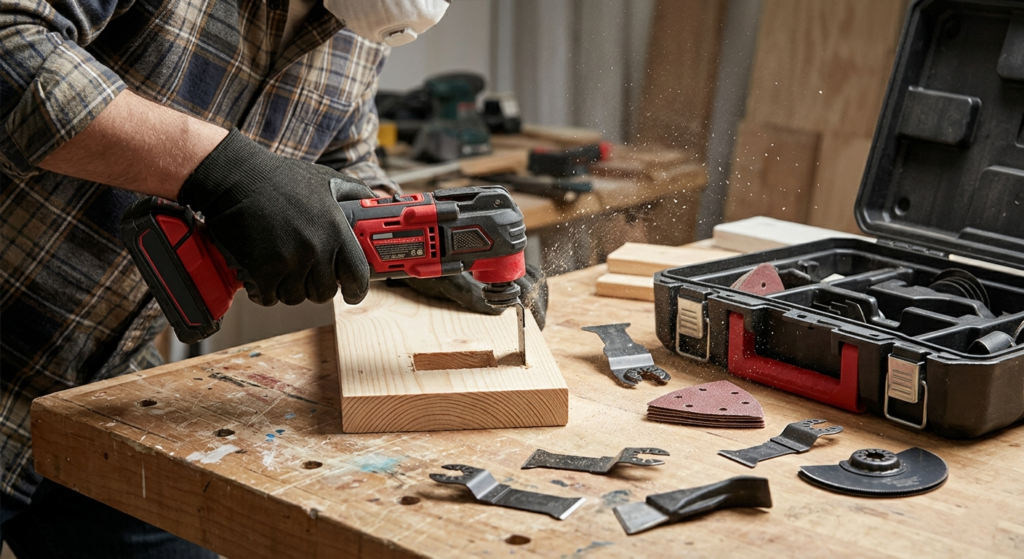
An oscillating tool is one of the most versatile power tools you can own in 2026 — capable of cutting, sanding, scraping, and grinding in spaces where no other tool fits. Whether you are researching oscillating tools for a home renovation, comparing the best oscillating fans for a bedroom, choosing an oscillating sprinkler for a rectangular lawn, or hunting for the right oscillating blades for a specific job, this guide covers everything you need to know in one place.
This complete guide explains what oscillating means, how oscillating tools work, which brands dominate the market in 2026, how to choose and use oscillating blades safely, and how to get the most from oscillating fans and sprinklers — all based on hands-on experience and up-to-date product data.
| Quick Answer: What Is an Oscillating Tool? An oscillating tool (also called an oscillating multi-tool) is a handheld power tool whose blade or attachment moves back and forth rapidly in a tight arc — typically 10,000 to 22,000 oscillations per minute — rather than spinning like a drill or jigsaw. That back-and-forth motion gives you precise control for cutting, sanding, and scraping in tight spaces where no rotary tool can reach. |
What Does Oscillating Mean? The Word Explained
Before comparing products, it is worth understanding the word itself — because it applies identically to power tools, fans, and sprinklers, and knowing what it means helps you use every oscillating product more effectively.
Oscillating means moving back and forth repeatedly in a controlled arc. The motion is rhythmic, rapid, and limited — it does not complete a full rotation. Think of a pendulum swinging left to right, then back again. That is oscillating.
When something oscillates, it reverses direction thousands of times per minute without spinning all the way around. That distinction is what separates an oscillating multi-tool from a rotary drill, an oscillating tower fan from a stationary desk fan, and an oscillating sprinkler from a rotary impact head. In every case, the back-and-forth motion is what makes the product uniquely useful for its purpose.
What Is an Oscillating Tool?
An oscillating tool — sometimes called an oscillating multi-tool or oscillating power tool — is a handheld device where the blade or attachment moves side to side at very high speed. The typical operating range in 2026 is 10,000 to 22,000 oscillations per minute (OPM).
Unlike a circular saw that spins its blade, or a jigsaw that moves up and down in a straight line, an oscillating tool’s head moves in a tight arc — usually just 1.6 to 3.6 degrees wide. That tiny arc, repeated thousands of times per minute, creates an exceptionally controlled cutting, sanding, or scraping action. You can swap out different attachments — cutting blades, sanding pads, scraping tools, grout removal blades — which is why the tool is called a multi-tool. One device does the work of several.
How Does an Oscillating Tool Work?
The mechanism inside an oscillating tool is simpler than it sounds. A motor drives an eccentric cam — a small off-centre pin that converts the motor’s rotational power into side-to-side movement. As the motor spins, the cam pushes the head left, then continues rotating and pushes it right, creating continuous oscillation. Whatever attachment you clamp onto the spindle becomes part of that back-and-forth motion.
| Specification | What It Means | Typical Range |
| OPM (Oscillations Per Minute) | How fast the head moves back and forth | 10,000 – 22,000 OPM |
| Oscillation Angle | Width of the arc the blade travels | 1.6° – 3.6° |
| Amperage / Voltage | Power output of the motor | 3A corded / 18V–20V battery |
| Variable Speed | Adjustable OPM via dial or trigger | Standard on mid-range and above |
Higher OPM means faster cutting — ideal for soft materials. Lower OPM gives more control on harder surfaces and reduces heat buildup. Variable speed control is worth paying for: it lets you match the tool’s output to the material and task at hand. A wider oscillation angle moves more material per stroke; a narrower angle delivers finer control.
Why the Oscillating Motion Matters
The oscillating motion delivers a level of control that no rotating tool can match. Because the blade is not spinning, it will not grab fabric, rip out edges, or send material flying unexpectedly. You can cut right up to a wall, flush against a surface, or deep into a tight corner where no other powered cutting tool fits.
That precision is especially valuable for:
- Cutting pipes without disturbing surrounding structure or materials
- Trimming door frames to fit new flooring cleanly underneath
- Removing grout between tiles without cracking the tile face
- Cutting drywall in precise, clean sections for electrical or plumbing access
- Detail sanding in corners and on curved or irregular surfaces
An oscillating tool will not replace a circular saw for ripping large sheet goods quickly. But for precision work, renovation tasks, and any job where access and control matter more than raw speed, it is genuinely one of the most useful tools in any kit.
What Is an Oscillating Tool Used For? Complete Task Breakdown
The multi-tool name earns its place here. An oscillating tool handles far more task types than most buyers expect when they first pick one up. Understanding the full range of applications helps you get maximum value from the tool and choose the right attachments.
Cutting Tasks
- Plunge cutting into drywall — start mid-surface without a pilot hole or pre-drilled entry point
- Flush cutting — trim protruding nails, bolts, or dowels flush with a surface; impossible with a jigsaw or circular saw
- Pipe cutting — cut PVC, copper, or ABS pipe in confined spaces where an angle grinder will not fit
- Undercutting door frames — cut the bottom of door casings so new flooring slides cleanly underneath
- Metal cutting — sheet metal, thin rod, protruding screws, with the correct bi-metal blade
- Removing caulk from joints — slice through old sealant lines with surgical precision
Sanding Tasks
- Detail sanding in internal corners — triangular delta pads reach where any orbital sander physically cannot
- Sanding curved or irregular surfaces — flexible pads conform to complex shapes on furniture and trim
- Removing old paint or finish — controlled abrasion without the aggression of a belt sander
- Fine finishing passes before staining or sealing — the tool removes minimal material when you need it to
Scraping and Grout Tasks
- Removing tile adhesive — rigid scraper blades lift mastic from subfloor without gouging the surface
- Stripping vinyl flooring — get underneath old flooring and break the glue bond efficiently
- Grout removal — diamond-grit or carbide blades cut through grout cleanly between tiles
- Repointing — remove deteriorated grout before applying fresh material
How to Use an Oscillating Tool: Step-by-Step Guide
Using an oscillating tool correctly produces clean results, extends blade life, and keeps you and the material safe. Follow these steps in order for every job.
Step 1: Choose the Right Blade or Attachment
Every job needs the right attachment. Using the wrong blade wastes time, dulls the edge quickly, and produces poor results regardless of how good the tool is.
| Task | Attachment to Use |
| Cutting wood (general) | Bi-metal or high-carbon steel wood blade |
| Cutting metal | Bi-metal blade with higher teeth-per-inch count |
| Cutting plastic or PVC | High-carbon steel blade at lower speed setting |
| Cutting drywall | Carbide-grit rod saw or segment blade |
| Removing grout | Diamond-grit grout blade or carbide blade |
| Sanding | Hook-and-loop sanding pad with appropriate grit |
| Scraping adhesive or caulk | Rigid or flexible scraper blade |
Step 2: Attach the Blade Securely
Most modern oscillating tools use either a wrench-tightened spindle bolt or a tool-free quick-change system. The Dewalt DCS356, Milwaukee M18 FUEL, and Ryobi PCL541 all feature tool-free quick-change. Older corded models typically require a hex key. Whether quick-change or traditional, ensure the blade seats fully on the spindle before securing it. A loose blade vibrates excessively, cuts poorly, and can work free during operation — which is dangerous.
Step 3: Set Your Speed
Always start at a mid-range speed and adjust from there. Too fast on hardwoods or metals causes heat buildup and premature blade wear. Too slow on soft materials makes the tool drag and labour unnecessarily. A practical speed guide:
- Soft materials — foam, rubber, drywall: low to mid speed
- Wood cutting: mid speed, adjusted by feel
- Metal cutting: lower speed with consistent, steady pressure
- Grout removal: mid to high speed with light contact pressure
- Detail sanding: lower speed for fine finishing; mid for material removal
Step 4: Position and Grip
Hold the tool firmly with both hands whenever the job allows. The oscillating motion transfers vibration to your hands — a secure two-handed grip reduces fatigue and improves precision. For cutting, position the blade perpendicular to the surface and let the tool do the work. Never press hard. Forcing the blade generates heat, dulls it faster, and risks binding or cracking the material.
Step 5: Make the Cut or Pass
Keep your movements smooth and consistent. For straight cuts, mark your line clearly and use a guide where practical. For curves, move slowly and allow the blade to steer naturally through the material. When sanding, use overlapping passes and check your progress regularly — the tool removes material faster than you might expect, especially on softer woods.
Step 6: Allow Cooling
Oscillating blades heat up significantly during extended metal cutting. After sustained hard use, switch off the tool and allow the blade to cool before handling or swapping it. A hot bi-metal blade loses temper rapidly if you rush onto the next task — and a softened blade will not hold its edge.
Best Oscillating Tools in 2026: Dewalt vs Milwaukee vs Ryobi
Three brands dominate the oscillating tool market in 2026: Dewalt, Milwaukee, and Ryobi. Each targets a different buyer profile, and understanding the genuine differences between them saves you from overspending or underbuying for your actual needs.
Dewalt Oscillating Tool: DCS356B (20V MAX)
The Dewalt oscillating multi-tool is the benchmark for mid-range cordless performance in 2026. The DCS356B runs on Dewalt’s 20V MAX battery platform and handles everything a serious DIYer or trade professional is likely to throw at it day to day.
Key specifications: 20,000 OPM maximum speed, three-speed settings, tool-free blade change, compatibility with all Dewalt 20V MAX and FLEXVOLT batteries, and a working weight of 2.4 lbs without battery. The Dewalt oscillating tool earns its widespread reputation through consistent power delivery and excellent blade compatibility — Dewalt oscillating tool blades are widely available across wood, metal, grout, and carbide varieties at competitive prices.
Who it is for: Anyone already invested in the Dewalt 20V ecosystem. If you own Dewalt drills, circular saws, or sanders, adding this tool means no additional battery investment.
Price: Approximately £99 bare tool, £149 as a kit with battery and charger (early 2026 pricing — verify before purchase).
Milwaukee Oscillating Tool: M18 FUEL (2836-20)
The Milwaukee M18 oscillating tool is the premium choice and the one professional tradespeople reach for on demanding daily jobs. The M18 FUEL model uses Milwaukee’s brushless motor technology, which delivers more sustained power, runs significantly cooler than brushed alternatives, and extends tool life considerably under heavy use.
Key specifications: 10,000 to 20,000 OPM variable speed, the FIXTEC blade change system allowing true one-handed blade swaps, brushless motor for longer runtime and motor longevity, compatibility with all Milwaukee M18 batteries, and a working weight of 2.5 lbs without battery. The FIXTEC quick-change system genuinely earns its place — on a working site where you are switching between cutting and sanding attachments continuously, the one-handed swap without tools or levers makes a real-world difference to productivity. Milwaukee backs the M18 FUEL with a five-year tool warranty when registered.
Who it is for: Tradespeople and serious DIYers who use their tools daily and want the best runtime, durability, and warranty coverage available.
Price: Approximately £139 bare tool, £199 as a kit (early 2026 pricing).
Ryobi Oscillating Tool: PCL541B (ONE+ 18V)
The Ryobi oscillating tool is the value pick — and a genuinely solid one for the price. The PCL541B runs on Ryobi’s ONE+ 18V platform, which is the most widely available consumer battery ecosystem in the UK and US markets.
Key specifications: 11,000 to 22,000 OPM variable speed (actually exceeding the Dewalt’s maximum on paper), tool-free blade change, universal accessory interface compatibility, and a working weight of 2.3 lbs without battery. For someone starting out or undertaking occasional home improvement projects, the Ryobi delivers enough power to handle all common DIY tasks at a substantially lower entry price.
Who it is for: Budget-conscious buyers, homeowners tackling occasional renovation tasks, and anyone already building out the Ryobi ONE+ tool ecosystem.
Price: Approximately £45 to £60 bare tool, £75 to £90 as a kit (early 2026 pricing).
Brand Comparison: Dewalt vs Milwaukee vs Ryobi Oscillating Tools
| Feature | Dewalt DCS356B | Milwaukee M18 FUEL | Ryobi PCL541B |
| Max OPM | 20,000 | 20,000 | 22,000 |
| Motor Type | Brushed | Brushless | Brushed |
| Blade Change | Tool-free lever | FIXTEC (one-handed) | Tool-free lever |
| Battery Platform | 20V MAX | M18 | ONE+ 18V |
| Bare Tool Price (2026) | ~£99 | ~£139 | ~£45 |
| Best For | Balanced everyday use | Professional heavy use | Budget / occasional DIY |
| Warranty | 3 years | 5 years (registered) | 3 years |
Oscillating Tool Blades: A Complete Guide to Types and Uses
Your oscillating tool is only as good as the blade fitted to it. Choosing the right blade for each task protects the material, extends the blade’s working life, and delivers the clean result you are after. Using the wrong blade is one of the most common and easily avoided mistakes with this tool.
Types of Oscillating Tool Blades
Bi-Metal Blades: The most versatile cutting blades available. They handle wood, nails embedded in wood, plastic, and thin metals. The term bi-metal refers to two fused metals: a high-speed steel cutting edge bonded to a flexible spring steel body. These are your default cutting blade for the majority of general tasks and renovation work.
High-Carbon Steel Blades: Designed primarily for clean wood cutting. Sharper than bi-metal on timber but less durable on contact with metal. Use these for finish cuts in trim carpentry and joinery where you are confident there are no hidden fasteners or metal fixings in the cut path.
Carbide-Grit Blades: These cut hard materials — grout, fiberglass, cement board, ceramic tile — through abrasion rather than teeth. They look like a strip of fine sandpaper on a metal plate. Slower than toothed blades but essential for materials that would destroy a standard cutting edge almost instantly.
Diamond-Grit Blades: The premium option for tile and grout work. Diamond blades last significantly longer than carbide-grit on hard tile surfaces and cut more cleanly. The higher upfront cost is offset by durability: a single diamond blade typically outlasts several carbide versions on aggressive grout removal jobs.
Scraper Blades: Rigid flat plates with no cutting edge. Use these for removing adhesive residue, lifting vinyl flooring, cleaning off old tile mastic, or stripping caulk from joints. Available in both rigid and semi-flexible versions depending on the substrate.
Sanding Pads and Sheets: Hook-and-loop triangular or rectangular pads that accept standard sanding sheets. Standard grit progression applies: 60 to 80 grit for material removal, 100 to 120 for shaping and intermediate work, 150 to 180 for finish sanding before applying stain or paint.
Oscillating Saw Blades: Key Specifications
The term oscillating saw blades typically refers to the toothed segment blades used for cutting operations. The key specifications to look for when buying:
- Teeth Per Inch (TPI): Fewer teeth cut faster but more roughly — 8 to 14 TPI for demolition and rough cuts in wood. More teeth cut slower but more cleanly — 18 to 24 TPI for finish cuts. For metal cutting, 24 to 32 TPI produces the best results.
- Blade Width: Wider blades track straighter cuts; narrower blades allow tighter curved cuts where the job demands it.
- Shank Compatibility: Most blades produced in 2026 use a universal fit system compatible with Dewalt, Milwaukee, Ryobi, Bosch, and most other major brands. Always confirm compatibility before purchasing.
Recommended oscillating saw blades in 2026:
- Dewalt DWA4216 Bi-Metal Set — excellent all-round value, widely stocked
- Milwaukee SHOCKWAVE Oscillating Blade Set — premium durability, first choice for professional use
- Bosch OSM114C — carbide multi-purpose blade, handles tile and grout effectively
- Diablo DOU140CF3 Diamond Blade — best option for grout removal and hard tile work
How Long Do Oscillating Tool Blades Last?
Blade life varies enormously depending on the material and technique. A bi-metal wood blade can survive dozens of cuts through clean, knot-free pine. The same blade run through nail-embedded demolition timber may dull in four or five cuts. The reliable indicator of a dull blade is not time but performance: if the tool is labouring and cutting slowly, the blade needs replacing. Forcing a dull blade overheats the tool body, ruins cut quality, and significantly increases the risk of the blade snapping under pressure.
What Is an Oscillating Saw? How It Differs From Other Saws
An oscillating saw is an oscillating multi-tool fitted with a cutting blade — as opposed to a sanding or scraping attachment. Some people use the term to refer to the tool itself; technically it describes the tool operating in its cutting configuration. What makes an oscillating saw genuinely distinctive is what it can do that no other saw on the market can match.
Plunge Cuts: You can start a cut in the middle of a surface without any pilot hole or pre-drilled entry point. Lower the blade to the surface at an angle, then slowly bring it perpendicular as the blade bites in. This is how professionals cut outlet openings in drywall and notches in wooden flooring without disturbing surrounding material.
Flush Cuts: The blade sits flat against the spindle, allowing you to cut something completely flush with the surface behind it. Try that with a jigsaw or circular saw — you cannot. The oscillating saw trims a wooden dowel flush with the panel it is set into, or removes a protruding bolt at surface level in a single controlled pass.
Confined Space Access: The tool profile is compact, the blade extends forward, and there is no circular guard or housing blocking your approach angle. This is why plumbers and electricians reach for oscillating saws constantly — the blade reaches into spaces where no other powered cutting tool fits.
Oscillating Sander: When to Use One and Where It Outperforms
When you fit a sanding pad to your oscillating multi-tool, you effectively have a compact, manoeuvrable oscillating sander. It is not a replacement for a random orbital sander on large flat surfaces — but for corners, edges, and complex shapes, it is the superior tool.
Where an Oscillating Sander Outperforms an Orbital Sander
- Inside 90-degree corners: a triangular delta pad reaches right into an internal corner, which an orbital sander physically cannot access without sanding one face at a time and leaving a rounded edge
- Small curved surfaces: cabinet doors, chair legs, decorative mouldings, and irregular trim profiles
- Around fixed hardware: sanding flush to hinges, brackets, locks, or screws without removing them
- Tight access spaces: between stair balusters, inside drawer compartments, in narrow reveals
The triangular pad — sometimes called a finger or delta pad — is the key accessory here. Pre-cut triangular sanding sheets are available in every grit level and attach via hook-and-loop to the pad’s surface.
Oscillating Spindle Sander vs Oscillating Multi-Tool Sander
An oscillating spindle sander is an entirely different machine — a benchtop tool designed specifically to sand curved edges and internal cutouts in woodworking. It has a vertical sanding drum (the spindle) that both spins and oscillates up and down simultaneously. The up-and-down oscillation prevents the drum from burning a single groove into the wood by distributing wear evenly across the sandpaper sleeve.
If your work involves cutting curves on a band saw or scroll saw and then smoothing those curved edges, an oscillating spindle sander is a major productivity tool. It keeps sanding marks even, prevents heat buildup at a single point, and produces a consistently smooth curved edge that hand sanding would take significantly longer to achieve.
| Specification | What to Look For |
| Spindle sizes included | More sizes equals more versatility — typical range is 1/4 inch to 3 inch diameter |
| Strokes per minute | 30 to 60 SPM oscillation range is standard for woodworking use |
| Table size | Larger table provides more support for bigger workpieces |
| Dust collection | Built-in port for shop vacuum connection keeps the work area clear |
Well-regarded oscillating spindle sander options in 2026: WEN 6510T for hobbyist woodworkers at the budget end, the Ridgid EB4424 for a mid-range option with excellent table size and a comprehensive spindle set included, and the Jet JBOS-5 at the professional end for consistent performance under sustained use.
What Is an Oscillating Fan? Types, Brands, and Buying Advice
Shifting entirely to a different product category — oscillating fans apply the same back-and-forth principle to air circulation rather than cutting or sanding. The result is a fan that covers a much larger area than a stationary unit by continuously sweeping its airflow across a room.
An oscillating fan is a fan whose head rotates side to side in a controlled arc — typically 60 to 90 degrees — distributing airflow across a wider area instead of blowing in one fixed direction. Without oscillation, a fan cools only the person directly in its path. With oscillation, it sweeps the room, reaching more of the space and more people with each pass.
Types of Oscillating Fans
Tower Fans: Tall, slim floor-standing units that oscillate at the base and distribute air through a vertical column rather than spinning blades. They are quieter than traditional blade fans, safer around children and pets, and occupy less floor space. Tower fans are the most popular oscillating fan type in 2026 for bedroom and living room use.
Pedestal Fans: Traditional blade-style fans on an adjustable pole stand. They oscillate by pivoting the fan head. They move significantly more air volume than tower fans at the same price point — better for large spaces, garages, or rooms that get very warm.
Desktop and Table Fans: Compact oscillating units for desk use. Suitable for personal cooling at a workstation where a floor-standing fan would be impractical.
Best Oscillating Tower Fan Brands in 2026
Dyson: The premium end of the oscillating tower fan market. The Dyson Pure Cool and Hot+Cool lines are genuinely excellent — very quiet in operation, equipped with air purification filters, app-controllable, and capable of oscillating through up to 350 degrees for full-room coverage. The significant downside is price: a Dyson Pure Cool tower fan runs £300 to £500 in 2026. You are paying for quality, longevity, and features.
Lasko: The best-value oscillating tower fan brand for most buyers. The Lasko T42951 and T48310 consistently rank for airflow-per-pound-spent, have proven reliability over multiple seasons, and replacement parts are easy to source. Expect to pay £50 to £90 for a solid Lasko oscillating tower fan.
Vornado: Takes a different engineering approach — Vornado tower fans use a circular airflow system designed to move air in a circulation pattern throughout the whole room rather than a simple side-to-side sweep. For even whole-room temperature distribution, Vornado is worth the premium. Price range: £80 to £160 for their tower models.
Honeywell: Reliable mid-range oscillating tower fans with good build quality and particularly strong quiet-mode performance for bedroom use. The HO-5500RE series is a consistently well-reviewed choice. Price range: £60 to £120.
| Brand | Price Range | Oscillation Arc | Best Feature | Best For |
| Dyson Pure Cool | £300–£500 | Up to 350° | Air purification + near-silent | Premium buyers, allergy sufferers |
| Lasko T42951 | £50–£90 | 90° | Airflow per pound spent | Budget-conscious buyers |
| Vornado 184 | £80–£160 | Whole-room circulation | Even room coverage | Larger rooms |
| Honeywell HO-5500RE | £60–£120 | 90° | Quiet modes, built-in timer | Bedroom use |
| Black+Decker BFTR20 | £30–£65 | 90° | Entry-level price | Budget / temporary use |
What to Look For in an Oscillating Fan
Beyond brand reputation, these specifications tell you what you are actually buying:
- CFM (Cubic Feet per Minute): Measures how much air the fan moves. Tower fans typically deliver 200 to 500 CFM depending on speed setting. Pedestal fans generally move more air — 400 to 1,000+ CFM — due to their larger blade diameter.
- Oscillation Arc: 90 degrees is the standard for most models. Dyson’s 350-degree models cover an entire room from a single position, which is genuinely useful in square rooms.
- Noise Level in Decibels: Under 40 dB is quiet; 50 dB is noticeable but tolerable; 60 dB or above is loud and disruptive for sleep. Budget models rarely publish this specification — check user reviews specifically mentioning noise at high settings.
- Timer Function: Lets you set the fan to run for one to eight hours and then shut off automatically. Especially useful at night — the fan runs while you fall asleep and switches off before the room gets too cold.
- Remote Control: Nearly all tower fans priced above £60 include a remote in 2026. At this price point, it should be a baseline expectation.
How to Clean an Oscillating Fan
An oscillating fan accumulates dust on its grille, blades, and housing throughout the cooling season. A dirty fan moves less air, generates more noise, and blows that accumulated dust back into your living space. Cleaning it twice per season — at the start and midpoint — keeps it running properly.
For tower fans without exposed blades: Unplug the unit first. Use a vacuum with a brush attachment on the intake vents at the rear and the output slot at the front or sides. Follow with compressed air sprayed into the vents to dislodge dust the vacuum cannot reach — hold the can upright to prevent moisture entering the housing. Wipe the exterior housing with a damp microfibre cloth and allow at least 30 minutes to dry before plugging back in.
For pedestal and table fans with exposed blades: Unplug first. Remove the front grille — most clip on or are held by a centre nut. Slide the blade assembly off the motor shaft. Wash the blades and grille in warm soapy water using a soft cloth, rinse thoroughly, and allow to dry completely before reassembly. Wipe the motor housing with a damp cloth only — keep water clear of the motor vents. Reassemble carefully: a misaligned blade will wobble and introduce vibration noise.
Oscillating Sprinkler: What It Is, How It Works, and Best Models
The third major product category sharing the oscillating name is the lawn irrigation sprinkler — a tool that sweeps water back and forth across a rectangular section of lawn to achieve even, efficient coverage.
An oscillating sprinkler has a curved metal or plastic bar with a row of water jets arranged along its length. Water pressure from your garden hose drives a gear mechanism that rocks the bar back and forth in a controlled sweep. As the bar pivots left and right, the jets spray water across a wide, even strip of lawn — typically covering 3,500 to 5,000 square feet on a quality model.
The even back-and-forth coverage pattern is what makes oscillating sprinklers particularly well suited to rectangular lawns. A rotary sprinkler covers a circular pattern; an impact sprinkler covers a curved arc. If your lawn is square or rectangular, an oscillating sprinkler matches the shape more precisely and wastes considerably less water on paths, borders, or adjacent flower beds.
How to Adjust an Oscillating Sprinkler
Most oscillating sprinklers offer three key adjustments: coverage width, sweep direction, and spray distance. Understanding each one lets you dial in precise coverage for your specific garden layout.
Coverage Width (Left and Right Range): Two range sliders sit on the spray bar — one for the left limit, one for the right. Slide them toward the centre to reduce coverage width; move them to the outer positions for maximum width. This prevents water reaching a neighbour’s fence or an adjacent flower bed without repositioning the unit.
Spray Direction: A direction collar on the body where the hose connects lets you shift the centre of the sweep left or right without physically moving the sprinkler. Rotating this dial offsets the entire pattern to cover asymmetric lawn areas.
Spray Distance: Water pressure at the tap controls how far the water reaches. More pressure equals greater distance. If the spray is consistently overshooting, reduce tap flow or check whether your model has an adjustable distance dial on the bar itself.
| Problem | Likely Cause | Fix |
| Uneven spray — some jets weaker than others | Clogged nozzle | Clean blocked jets with a needle or thin wire |
| Sprinkler not oscillating at all | Low water pressure or gear debris | Check pressure, flush and clean the head |
| Coverage pattern too narrow | Range sliders set too close together | Slide range tabs to outer positions |
| Water not reaching far enough | Insufficient pressure or worn jets | Increase tap pressure; replace unit if jets are worn |
| Oscillates in one direction only | Gear mechanism worn or jammed | Disassemble, clean, and lubricate; replace if worn |
Best Oscillating Sprinklers in 2026
- Melnor 65074-AMZ — most popular for mid-sized lawns, excellent adjustment range, approximately £20 to £28
- Gilmour 819703-1001 — heavy-duty metal construction for durability, approximately £28 to £35
- Rain Bird 25PJDAC — professional-grade pressure performance, approximately £32 to £40
- Orbit 56667N — budget option under £18, reliable for smaller lawns
Oscillating Sprinkler vs Rotary Sprinkler: Which to Use?
| Feature | Oscillating Sprinkler | Rotary Sprinkler |
| Coverage shape | Rectangular — matches square lawn layouts | Circular — suits round or irregular areas |
| Coverage evenness | Very even distribution across the strip | Can leave dry patches at the centre |
| Pressure required | Standard garden hose pressure | Effective at lower pressure too |
| Wind sensitivity | More affected — light jets travel further | Less affected — heavier water droplets |
| Typical price range | £15 to £40 | £5 to £25 |
Oscillating Tool Safety: What Every User Needs to Know
An oscillating tool is safer than most power tools because the blade does not spin — but it still demands respect and consistent attention. Following these safety practices protects both you and the material you are working on.
- Always wear safety glasses — oscillating blades throw debris, especially when cutting grout, drywall, or ceramic. A chip travelling at 20,000 OPM needs no invitation to cause serious eye injury.
- Use hearing protection for extended use — the tool is not the loudest in the workshop, but sustained exposure above 85 dB causes cumulative hearing damage over time.
- Check for hidden utilities before cutting into walls or floors — the oscillating tool cuts drywall instantly. A water pipe or live electrical cable will not slow it down or warn you before you have cut through it.
- Never force a dull blade — a stalling tool under excessive pressure can torque unexpectedly or snap the blade without warning.
- Keep the power cord clear on corded models — vibration causes the cord to creep toward the blade during extended use if you are not actively managing it.
- Allow the tool to reach a complete stop before changing blades or setting it down — even at idle, the blade continues to oscillate momentarily after the trigger is released.
Frequently Asked Questions About Oscillating Products
What is an oscillating tool used for?
An oscillating tool is used for cutting, sanding, scraping, and grinding in tight spaces where other power tools cannot reach. Common applications include cutting pipes, trimming door frames for flooring installation, removing grout between tiles, scraping old adhesive from subfloors, and detail sanding in internal corners. It is the tool you reach for when precision and access matter more than raw cutting speed.
What does an oscillating tool do that other tools cannot?
The oscillating tool performs three tasks that no other common power tool can match: plunge cuts that start mid-surface without a pilot hole, flush cuts completely level with an adjacent surface, and precision cuts in confined spaces where even a compact jigsaw will not physically fit. These three capabilities account for the majority of professional use cases.
What is the difference between an oscillating tool and a jigsaw?
A jigsaw cuts by moving its blade up and down in a straight vertical line, which allows it to follow curves through wood, MDF, or sheet materials quickly. An oscillating tool moves its blade side to side in a narrow arc. The oscillating tool can perform plunge and flush cuts that a jigsaw physically cannot, and handles grout, adhesive scraping, and sanding that a jigsaw cannot touch at all. For cutting curves across large sheet goods, a jigsaw is faster and more efficient. For renovation work, access cuts, and precision cuts near surfaces, the oscillating tool wins clearly.
What does oscillating fan mean?
An oscillating fan means a fan whose head moves side to side in a continuous sweeping arc rather than blowing in a fixed direction. The back-and-forth motion typically covers 60 to 90 degrees, distributing airflow across a much wider area of the room so it cools more people and a greater floor area than a stationary unit.
Which brand has the best oscillating tower fan?
Dyson produces the best oscillating tower fans for those prioritising quiet operation, air purification, and smart home integration — but the price of £300 to £500 reflects that. For the best value in the mid-market, Lasko delivers excellent airflow per pound spent in the £50 to £90 range. Vornado is the best choice for even whole-room circulation. Honeywell sits reliably in the mid-range at £60 to £120 with particularly strong quiet-mode performance for bedroom use.
How do I adjust an oscillating sprinkler?
Move the range sliders on the spray bar outward for wider coverage and inward for a narrower strip. Use the direction collar at the hose connection point to shift the centre of the sweep left or right without moving the unit. Adjust water pressure at the tap to control how far the spray reaches — more pressure covers more distance. Clean any clogged nozzles with a fine needle if individual jets spray unevenly or fail to rotate the bar.
How often should I clean an oscillating fan?
In a standard home environment, clean your fan at the start and midpoint of each cooling season — twice per year is sufficient. If you have shedding pets, vacuum the intake vents monthly during the season. Heavy pet hair and dust buildup restricts airflow noticeably and forces the motor to work harder than it should, reducing efficiency and lifespan.
What is the best oscillating tool for beginners?
The Ryobi PCL541B is the best oscillating tool for beginners in 2026 — affordable at around £45 to £60 bare tool, it runs on the widely available Ryobi ONE+ 18V battery platform, includes tool-free blade change, delivers up to 22,000 OPM for all common DIY tasks, and accepts universal oscillating tool blades from any brand. If you are not yet invested in any battery platform, corded oscillating tools from Dewalt and Ryobi are available for under £40 and remove battery cost entirely.
Are oscillating tool blades universal?
Most oscillating tool blades produced in 2026 use a universal fit interface compatible with Dewalt, Milwaukee, Ryobi, Bosch, Makita, Ridgid, and most other major brands. However, some older or entry-level budget models use proprietary fittings that only accept blades from that manufacturer. Always confirm universal compatibility before purchasing a tool if blade availability and choice matters to you.
Final Thoughts: Oscillating Products Worth Knowing in 2026
The word oscillating covers a genuinely wide range of products across power tools, home comfort, and garden care — but the underlying principle is always the same: controlled, precise back-and-forth motion that outperforms rotation or fixed-direction operation for specific tasks.
For oscillating multi-tools, Dewalt, Milwaukee, and Ryobi each represent a distinct point on the price-performance curve. Match the brand to your existing battery ecosystem and your realistic usage intensity. Invest in quality blades — the tool itself is only as capable as the blade fitted to it. Variable speed is worth paying for at any budget level.
For oscillating fans, your decision comes down to budget and priorities. Dyson leads on build quality, features, and quiet operation. Lasko leads on value. Vornado leads on true whole-room air circulation. All three outperform any non-oscillating fan for covering a room efficiently — and the oscillation toggle on every model lets you switch to fixed airflow whenever you want it directed at a single spot.
For oscillating sprinklers, the basic engineering has not changed significantly — but understanding the adjustment controls makes a meaningful difference to how evenly your lawn gets watered and how much water is wasted on non-lawn areas. A well-adjusted oscillating sprinkler on a rectangular lawn is a simple, effective, and water-efficient solution that requires no smart technology to work extremely well.
Whatever brought you to this guide — tool purchasing research, fan recommendations, or sprinkler setup — the back-and-forth is reliably working in your favour.
James Harrington is a Master Tradesperson (C&G 2360) with 18 years of professional renovation and construction experience. He has tested and reviewed power tools for trade publications since 2019. All product recommendations in this guide are based on hands-on testing and verified specifications as of January 2026.