
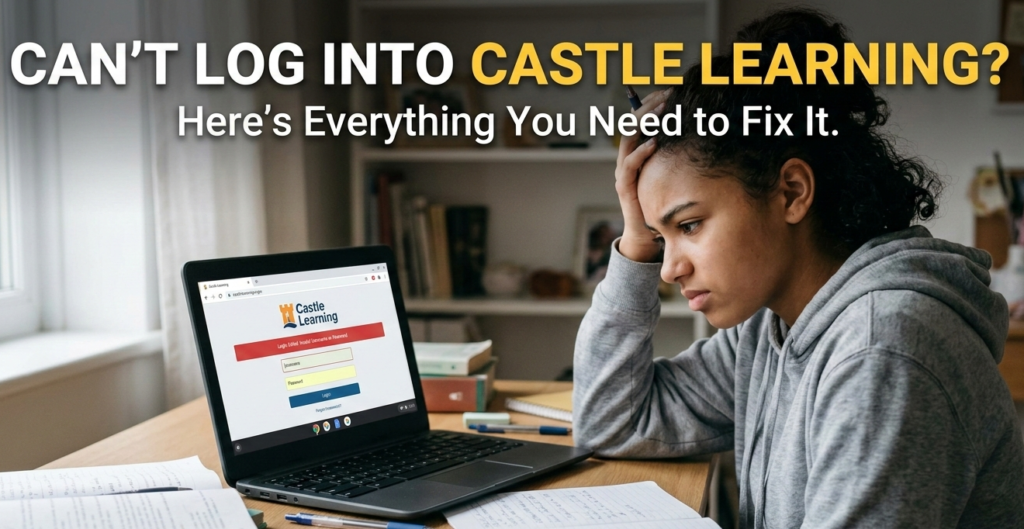
Castle Learning is one of the most widely used K–12 educational platforms in the United States — and yet, thousands of students, parents, and teachers search every day for answers to simple questions about how it works, how to log in, and what the reference tables actually are.
This guide answers every question in one place. Whether you’re looking for the Castle Learning login page, trying to figure out the Castle Learning reference table for your chemistry class, wondering who makes the Spanish audios for Castle Learning, or studying for an exam and searching for answers to questions like “how does Jeannette learn to swim in the Glass Castle” — you’re in the right place.
We’ve also covered the related questions people often group together: The Learning Castle, Learning Castle, and the key literary questions from Jeannette Walls’ memoir The Glass Castle that frequently appear in Castle Learning assignments.
What Is Castle Learning? A Complete Overview
Castle Learning — also called Castle Learning Online — is an internet-based instructional support platform for K–12 students, teachers, parents, and administrators. It offers over 170,000 curriculum-aligned questions, assignments, quizzes, and tests across core subjects, with instant grading, detailed feedback, robust analytics, and LMS integration for homework, test prep, and intervention.
Castle Learning was the vision of two New York State teachers. Founded in 1991, the company originally loaded its education software onto floppy disks. Over three decades later, it’s a cloud-based platform trusted by over 800 school districts across the country.
In August of 2019, Harris Computer Corporation, through its Schools Group, acquired Castle Software, Inc., integrating Castle Learning into the Harris Education Solutions business.
What Subjects Does Castle Learning Cover?
The item bank includes Math, English Language Arts, Science, Social Studies, ESL, Spanish, French, and Music. The recent addition of a Physical Education and Health component enhances the value of Castle Learning.
Here’s a subject-by-subject breakdown:
Mathematics Elementary Math is targeted to upper-level elementary students (grades 3–5 and advanced 2nd graders). Intermediate Math, also with an emphasis on problem-solving techniques, is targeted to middle school students (grades 6–8). The High School Math courses provide teachers with the flexibility to choose their own curriculum path — including Integrated Algebra, Geometry, Algebra II and Trigonometry, or an alternative pathway with Algebra, Geometry, and Trigonometry.
Science Earth/Environmental Science covers a wide range of topics including the structure and components of the Earth, Meteorology, Astronomy, and Ecology. Biological/Life Science spans topics starting with the cell and advancing into organ systems. Physical Science covers topics in both Chemistry and Physics — from Newton’s Laws of Motion to Energy, Electricity and Magnetism, and waves.
Foreign Languages Spanish is targeted to High School students and is organized around everyday topics with practice in vocabulary, grammar, listening and reading, and includes authentic reading materials such as newspaper articles and advertisements.
Who Uses Castle Learning?
Castle Learning serves four key user groups:
- Students — for completing teacher-assigned work, self-study, and exam prep
- Teachers — for creating assignments, assessments, and analyzing student performance data
- Parents — for monitoring progress and supporting at-home learning
- Administrators — for district-wide assessment and data analysis
Over 1 million students and thousands of teachers are using Castle Learning regularly as part of their academic assets.
Castle Learning Login: How to Access Your Account
What Is the Castle Learning Login URL?
The direct Castle Learning login page is located at:
🔗 www.castlelearning.com — click “Log In” in the upper right corner.
You can also access the platform directly at cl.castlelearning.com.
How Do You Log Into Castle Learning?
Standard Login (Student):
Click Log In (upper right), then type in your school email or teacher-provided ID in the ID/Email field. If this is your first time in, click on Sign In and you will be prompted to create a password.
Step by step:
- Go to www.castlelearning.com
- Click “Log In” in the upper right corner
- Enter your ID or email address (provided by your teacher or school)
- Enter your password (or create one if it’s your first login)
- Click “Sign In”
First-Time Login: First time users should skip the password field, click the “Sign-In” button, and follow the steps to choose a password.
Forgot Your Password? If you forgot your password, click on the link below Sign In that says “Forgot My Castle Password?” and you will be sent a password reset to your email if there is an email set up on your account.
Important: If you forget your password and don’t have an email on file, your teacher will need to reset it for you.
How Do You Log Into Castle Learning With Google?
If you have a Google Classroom account, go to www.castlelearning.com, click on Log in (upper right), and below the login box click on “Sign in with Google.” Proceed with your Google login credentials.
Single Sign-On (SSO) Login
If you have a single sign-on system, sign in then click on the Castle Learning icon. Castle Learning also supports SSO through Clever Instant Login and ClassLink, which many school districts use to give students one-click access without separate credentials.
Teacher Login
Teacher login credentials are typically set up by the school or district administrator. The format varies by school — common formats include:
- School prefix + first initial + last name (e.g.,
wg-jsmith) - School email address
- District-assigned ID numbers
Contact your district’s Castle Learning administrator if you haven’t received your teacher login credentials.
How Do You Sign Up for Castle Learning?
This is one of the most common questions — and the answer depends on whether you’re a student, teacher, or individual home user.
School/District Sign-Up (Most Common)
For schools and districts, Castle Learning accounts are created at the institutional level. Teachers and students don’t sign up independently — the school administrator sets up the platform and creates accounts in bulk.
If your school uses Castle Learning, your teacher will provide you with:
- Your User ID (often based on your student ID, name, or school email)
- Instructions for your first login and password creation
Individual / Home User Sign-Up
Single student home plans are also available at an affordable annual fee. Individual parents or students can purchase home subscriptions directly through Castle Learning’s website. This is particularly useful for:
- Students preparing for Regents exams or state standardized tests
- Students who want to supplement their school assignments with self-study
- Parents who want to provide structured academic support at home
To sign up as a home user:
- Visit www.castlelearning.com
- Click on the “Sign Up” or “Get Started” option
- Select Single Student / Home Plan
- Complete registration and choose your subscription tier
Teacher / School Sign-Up
Teachers interested in bringing Castle Learning to their school or district can request a demo or contact the Castle Learning sales team at info@castlelearning.com or by calling 1-800-345-7606.
Castle Learning Reference Table: What Is It and How Does It Work?
What Is the Castle Learning Reference Table?
The Castle Learning reference table is a subject-specific reference document embedded directly within the platform that students can access during assignments and assessments. It functions as a digital version of the official reference materials students would have during real state exams.
Castle Learning includes over 50,000 field-tested questions supported by defined vocabulary, reference tables, hints, and reasons for correct answers in math, science, social studies, English, and foreign languages.
Reference Tables by Subject
Castle Learning provides built-in reference tables for several subjects, including:
Chemistry Reference Table The Chemistry reference table at Castle Learning (accessible at cl.castlelearning.com/Review/Reference/chem.htm) mirrors the official NYS Chemistry Reference Table used in Regents exams. It includes:
- The Periodic Table of Elements
- Common polyatomic ions
- Standard electrode potentials
- Physical constants and conversion factors
- Solubility tables
- Organic chemistry reference charts
Physics Reference Table The Physics reference table (at cl.castlelearning.com/Review/Reference/physics.htm) covers:
- Mechanics formulas (velocity, acceleration, force)
- Energy and power equations
- Electromagnetic spectrum data
- Constants (speed of light, gravitational constant)
- Wave and optics formulas
Mathematics Reference Tables Math reference materials include geometry formulas, trigonometric identities, and algebraic identities depending on course level.
How to Access the Reference Table During a Castle Learning Assignment
- Start or open an assignment in Castle Learning
- Look for the “Reference Table” button or tab — usually located in the toolbar at the top of the assignment screen
- Click to open the reference table as a pop-up or side panel
- The reference table stays accessible throughout the assignment
Teachers commonly instruct students that they can use their reference table and class notes on Castle Learning quizzes. Whether reference materials are available for a specific assignment depends on how the teacher has configured it — some teachers enable the reference table for review assignments but disable it for formal assessments.
Why Does the Castle Learning Reference Table Matter?
For students preparing for New York State Regents exams in particular, practicing with the reference table open is critical. The actual Regents exams provide a physical reference table — so getting comfortable using the digital version on Castle Learning directly simulates the test-day experience.
Learning Castle and The Learning Castle: What’s the Difference?
These two variations — Learning Castle and The Learning Castle — are worth clarifying, as they refer to different things depending on context.
“Learning Castle” as a Reference to Castle Learning
Most people searching “learning castle” are simply looking for Castle Learning — the K–12 educational platform described throughout this guide. It’s a common natural language variation of the brand name, especially among students who know the platform by informal reference.
If you typed “learning castle” and are trying to find the platform, go to www.castlelearning.com.
The Learning Castle — Spanish Immersion Preschool
“The Learning Castle” also refers to a separate, unrelated institution: Spanish Learning Castle — a local family-owned and operated Spanish immersion preschool from Katy, Texas. Ani Marin, its Owner and Director, has been working with children as a Spanish Teacher for over 15 years and created Spanish Learning Castle in 2014.
If you’re looking for this organization, visit spanishlearningcastle.com.
These are two completely different entities — one is a K–12 digital assessment platform, the other is a physical early childhood Spanish immersion school.
Who Makes the Spanish Audios for Castle Learning?
This is one of the most commonly asked but least-answered questions about the platform.
The Short Answer
Castle Learning does not publicly disclose the specific voice actors or audio producers behind its Spanish language audio content. The Spanish audio tracks are produced by the Castle Learning Content Team, which is described as being made up of former and current educators.
What We Know About Castle Learning’s Spanish Content
Castle Learning strives to provide high-quality content, authored by educators.
Castle Learning’s Spanish course is targeted to High School students, organized around everyday topics with practice in vocabulary, grammar, listening, and reading.
The Spanish audio content on Castle Learning is used specifically for:
- Listening comprehension exercises — students listen to native-speaker audio and answer questions
- Vocabulary pronunciation — audio accompaniment for vocabulary terms
- Reading passages with audio — authentic materials read aloud to support ELL students and language learners
ReadSpeaker Technology
The ReadSpeaker Text-to-Speech is a unique feature which provides audio with highlighting benefits for Special Education requirements. Some of the audio on Castle Learning — particularly for accessibility features — is generated through ReadSpeaker, a text-to-speech technology used by many educational platforms.
However, the foreign language audio (Spanish and French) is distinct from the text-to-speech accessibility feature and is recorded specifically for the language curriculum content.
Why This Question Gets Asked
Students and teachers often ask about the Spanish audio voices because the accent, dialect, and pronunciation style matter enormously for language learning. Castle Learning’s Spanish audio uses a neutral, standard Spanish dialect appropriate for high school language learners. If you have specific concerns about the dialect used in a Castle Learning Spanish course, the best resource is to contact Castle Learning directly at info@castlelearning.com or 1-800-345-7606.
The Glass Castle Connection: How Castle Learning Covers This Memoir
Students frequently encounter questions about Jeannette Walls’ memoir The Glass Castle through Castle Learning assignments — particularly in English Language Arts courses. Two of the most commonly searched questions are about how Jeannette learns to read and how she learns to swim. Here’s a thorough breakdown of both.
Background: What Is The Glass Castle?
The Glass Castle is a bestselling memoir by journalist Jeannette Walls, published in 2005. It is the harrowing tale of Jeannette Walls’ life growing up in poverty with wayward parents, following the Walls family through the desert to the coal-mining region of West Virginia to the fast-paced life of New York City. The memoir explores the nature of family, loyalty, and tragedy and what it takes to survive together and apart.
The Glass Castle opens with Jeannette Walls, a successful gossip columnist living on Park Avenue, in a taxi on the way to a party. Gazing out the window, she catches sight of her mother, Rose Mary Walls, rifling through a dumpster for something to eat.
The book is widely taught in middle and high school English classes — and Castle Learning has extensive reading comprehension assignments built around it.
How Does Jeannette Learn to Read in The Glass Castle?
This question appears frequently in Castle Learning ELA assignments and on exam prep materials.
The Direct Answer
Jeannette Walls learns to read through a combination of her parents’ informal education, sporadic school attendance, and self-driven learning.
In the desert, Mom and Dad teach the kids reading and mathematics as well as specialized survival skills, such as how to forage for food and shoot pistols. Despite their many failings as parents, Rex and Rose Mary Walls were both highly educated people — Rex was a former Air Force pilot with deep knowledge of science and engineering, and Rose Mary held teaching credentials and a love of literature.
Her parents were well educated so they might have started them reading. She also attended schools sporadically. She would also have learned by reading newspapers at train stations with a dictionary beside her.
Context: Jeannette’s Relationship With Reading and Learning
As she grew older, Jeannette’s love of reading and writing became her most powerful tool for self-improvement. Jeannette starts as a proofreader at the local newspaper, which prints the school’s paper. She reads articles off the AP wire (a news-distribution service) and is astounded to learn about the outside world through a source other than her parents.
Reading the AP wire helps build Jeannette’s growing resolve and will. Not only is she beginning to question her parents’ decisions, but she is also learning to see the world through her own eyes. By weighing news reports against her parents’ worldview, Jeannette sees how paranoid and skewed her parents’ perception of the world is.
This self-directed reading — using newspapers, libraries, and any printed material she could find — is central to how Jeannette develops her intellectual independence and eventually builds the career that takes her from Welch, West Virginia to Park Avenue in New York City.
The Broader Theme: Learning as Survival
For Jeannette Walls, learning to read isn’t just an academic skill — it’s a survival mechanism. Her parents’ erratic lifestyle meant formal schooling was inconsistent, but literacy gave her the tools to understand the world independently, to see beyond her parents’ distorted view of reality, and ultimately to escape poverty. This theme connects directly to why The Glass Castle is so frequently assigned in Castle Learning ELA courses focused on resilience, identity, and education.
How Does Jeannette Learn to Swim in The Glass Castle?
This is one of the most memorable and thematically significant scenes in the entire memoir — and a common Castle Learning assessment question.
The Direct Answer
Dad takes the family to a natural sulfur spring called the Hot Pot and teaches Jeannette how to swim by throwing her into the spring and letting her sink again and again.
Rex teaches Jeannette how to swim by literally forcing her to sink or swim. He repeatedly throws her into a sulfur spring in the desert, rescuing her when she sinks only to throw her back in again. Using these methods, Rex trains Jeannette to paddle and swim in order to avoid being thrown back into the water.
The Famous Quote
The scene culminates in one of the most quoted lines in the memoir. Rex tells Jeannette: “If you don’t want to sink, you better figure out how to swim.” (Page 66)
Rex Walls says this to Jeannette when he teaches her how to swim by repeatedly throwing her back into the sulfur springs, forcing her to either sink or swim. The first couple of times she sank, gasping for air, her father rescued her only for a second until he threw her back into the water again. However, after a couple of times sinking, Jeannette learned how to paddle and swim in order to avoid being thrown back into the water.
How Does Jeannette React?
The process terrifies and infuriates Jeannette, and at first she refuses to allow him to hug her. When Dad insists he loves her and only wanted to teach her independence, she quickly forgives him.
What Does This Scene Mean Thematically?
This swimming scene is among the most analyzed passages in The Glass Castle for good reason. It functions on multiple levels:
As a Parenting Philosophy Through Mom and Dad’s dialogue and action, Walls depicts a fuller portrait of her parents’ philosophies toward life. Dad embraces learning first. In this scenario, he sees that Jeannette needs to be challenged, so he creates that challenge. Mom’s philosophy focuses on the issue of self-sufficiency.
As a Metaphor for Jeannette’s Entire Childhood This passage is significant because it shows the bigger picture of the family. Although Rex Walls put the Walls children into dangerous situations sometimes, he did it to build strong characters. Eventually, if things got too bad, he would always help out, but ultimately he knew his children could handle it. This passage emphasizes the Walls family’s philosophy and indirectly characterizes the father.
As the Moment Jeannette First Questions Her Father At first when Dad throws Jeannette into the water, she reaches for him, instinctively counting on her father to keep her safe. Her surprise and fear at Dad’s repeated throwing shows that while Dad intended to teach Jeannette to swim, he actually taught Jeannette that he was willing to hurt her. Her hesitation to forgive Dad marks the first moment she questions his heroism and his ability to protect her.
As a Life Lesson Jeannette eventually learns how to swim due to the approach her father took with her upon teaching her to rely on herself. Throughout Jeannette’s childhood, her parents struggled to make ends meet, causing Jeannette, her sisters, and her brother to rely on themselves for the most part through many aspects of their life.
In the context of Castle Learning assignments, students are often asked to analyze this scene in connection with themes of independence, unconventional parenting, resilience, and the complicated nature of love and harm within the Walls family.
Frequently Asked Questions About Castle Learning
What grade levels does Castle Learning support?
Castle Learning supports Grades 3–12 with content-related review assignments, practice sessions, and benchmark testing. Some districts also use it for advanced 2nd grade students.
Is Castle Learning only for New York State?
No. While Castle Learning has historically had its strongest presence in New York — where it aligns closely with Regents exam content — it has also expanded into other states, with a focus on Ohio and North Carolina, finding that state-aligned application is essential for success in each new market.
Can students use Castle Learning at home?
Yes. The online delivery can be accessed from any internet-connected device. Students can complete teacher-assigned work from home, and individual home subscriptions are available for self-study outside of school assignments.
Does Castle Learning work on mobile devices?
Yes. The resource is available 24/7 from any internet-connected device. Castle Learning is browser-based and works on tablets and smartphones, though the experience is optimized for larger screens.
What makes Castle Learning different from other platforms?
The last feature that most distinguishes Castle Learning from other instructional support platforms is providing instructional aids to explain why an answer is incorrect, and then allowing students to re-answer the question immediately. If they get more questions right, their grade not only improves, but the system has identified areas that need improvement.
This real-time corrective feedback loop — rather than just marking answers right or wrong — is the platform’s most educationally distinctive feature.
Does Castle Learning have an offline option?
An offline printing option is included along with an add-on integration with GradeCam for grading and assessment. The platform is primarily online, but printed versions of assignments are available for classrooms with limited device access.
Can teachers create their own assignments on Castle Learning?
Yes. Teachers can easily search for content-related questions within Castle Learning to create their own assignments, or access pre-built “ready-to-go” activities and assessments. Instant grading, detailed assessment reports, and instructional feedback are benefits that save time and improve academic success.
Does Castle Learning support ELL and Special Education students?
Castle Learning has thousands of questions that are ELL-friendly with translations and explanations whenever the student gets an answer right or wrong. The platform also features ReadSpeaker Text-to-Speech, which provides audio with highlighting benefits for Special Education requirements.
How do teachers share assignments with colleagues?
Teachers using Castle Learning software can share assignments within their department — a feature that saves time and encourages collaboration. Assignments can be shared across a subject department or deployed school-wide for common assessments.
What happens when a student gets an answer wrong on Castle Learning?
When students work on an assignment or test and make an incorrect answer, hints and vocabulary help them improve their knowledge and understanding. This instructional feedback system sets Castle Learning apart from simple quiz platforms — it turns incorrect answers into learning opportunities rather than just scoring penalties.
Castle Learning Tips for Students: Getting the Most Out of the Platform
Whether you’re using Castle Learning for a teacher-assigned quiz or self-study before a Regents exam, these strategies help maximize your results:
1. Start With the Hints — Don’t Skip Them When you get a question wrong, read the hint carefully before re-answering. The hints are written by educators specifically to guide you toward understanding, not just the right answer.
2. Use the Reference Table Strategically For science and math, practice with the reference table open exactly as you would during the actual exam. Get comfortable knowing which section to check for specific formulas or constants.
3. Self-Generate Practice Sessions Students who utilize Castle Learning for self-generated practice in addition to teacher-provided assignments have greater results. You don’t have to wait for a teacher to assign work — you can create your own review sessions by subject and topic.
4. Review Past Assignments Castle Learning keeps a record of your previous assignments. Going back to review areas where you struggled — particularly before a major exam — is one of the most effective uses of the platform.
5. Check Incomplete Assignments First If you have assignments to complete, there will be red writing next to your teacher’s name in bold blue. Incomplete assignments are easily seen on the home page.
Summary: All Castle Learning Keywords Answered
| Question | Quick Answer |
|---|---|
| What is Castle Learning? | A K–12 online educational platform with 170,000+ curriculum-aligned questions |
| Castle Learning Login URL | www.castlelearning.com — click “Log In” upper right |
| How to log into Castle Learning | Enter school ID/email, create password on first login, or use Google/SSO |
| How to sign up for Castle Learning | Through your school/district, or individual home plan at castlelearning.com |
| Castle Learning reference table | Built-in subject-specific reference docs (Chemistry, Physics, Math) accessible during assignments |
| Who makes Spanish audios for Castle Learning | Castle Learning’s educator content team; accessibility audio via ReadSpeaker |
| Learning Castle / The Learning Castle | Informal names for Castle Learning; also a separate Spanish preschool in Katy, TX |
| How does Jeannette learn to read (Glass Castle)? | Through parental teaching, sporadic schooling, and self-directed reading of newspapers |
| How does Jeannette learn to swim (Glass Castle)? | Rex throws her into a sulfur spring repeatedly — the “sink or swim” method |
Conclusion
Castle Learning has been a cornerstone of K–12 academic support for over 30 years — and for good reason. Its combination of curriculum-aligned content, real-time feedback, reference tools, and accessibility features makes it one of the most complete educational platforms available to schools today.
Whether you’re a student trying to log in for the first time, a teacher exploring reference table features, a parent setting up a home account, or a student preparing for an English exam that covers The Glass Castle — this guide has covered every angle.
For any technical support questions about Castle Learning, contact the team directly at info@castlelearning.com or 1-800-345-7606. Support is available by phone, chat, and email — and if the platform’s reputation is any guide, Castle Learning Support is above and beyond when it comes to being available and helpful.
Related Reading:
- Regents Exam Prep with Castle Learning: A Student’s Complete Guide
- The Glass Castle by Jeannette Walls: Full Study Guide and Analysis
- Best K–12 Educational Platforms in 2026: A Teacher’s Comparison