
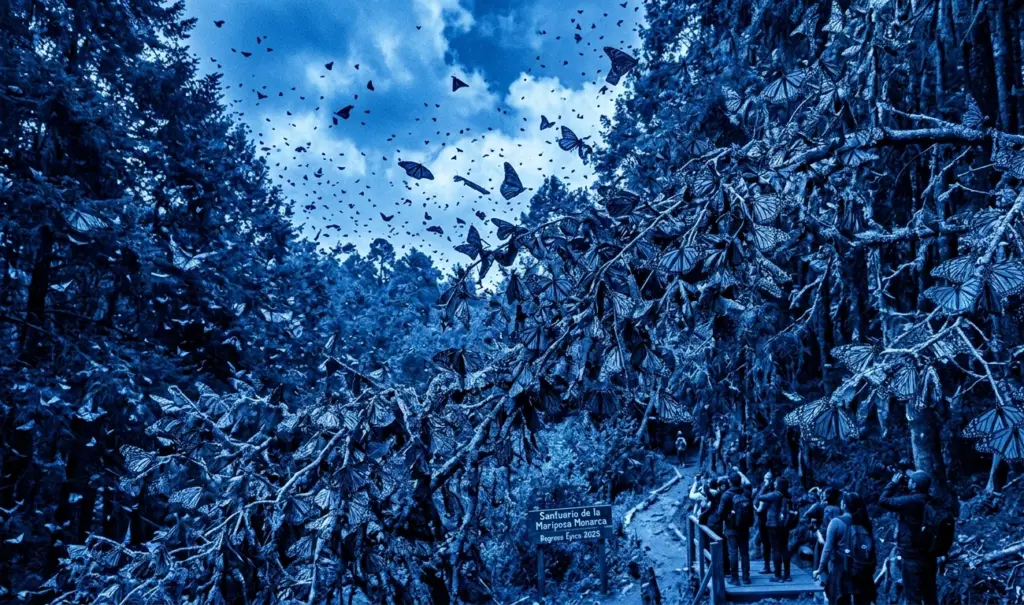
There are few stories in the natural world as exciting as this: monarch butterflies are making a grand return in the 2025-2026 season. After years of worrying decline that threatened one of the planet’s most extraordinary migratory phenomena, the monarch butterfly is back with renewed strength, filling scientists, conservationists, and indigenous communities in Mexico with hope.
During the 2024-2025 hibernation season, the eastern migratory monarch butterfly population nearly doubled, according to the annual report published by the World Wildlife Fund (WWF) in collaboration with Mexico’s National Commission of Natural Protected Areas (CONANP). The butterflies occupied 1.79 hectares of forest—a 99% increase compared to the 0.90 hectares recorded the previous winter.
This is the return we’ve all been waiting for. And in this article, we’ll tell you everything you need to know about why monarch butterflies are making such a grand comeback, what has made this recovery possible, where and when to see them in Mexico, and what we can all do to ensure this return is permanent.
Why Are Monarch Butterflies Making a Big Comeback in 2025?
The massive return of monarch butterflies in 2025 did not happen by accident. It is the result of a combination of favorable natural factors and years of consistent conservation work in three countries — Mexico, the United States, and Canada.
Favorable Climatic Conditions During Migration
One of the most important factors that contributed to the remarkable population increase was a more favorable climate during the 2024 migration. The head of CONANP, Pedro Álvarez-Icaza, explained at a press conference that the increase was mainly due to more favorable weather conditions, with a less intense drought during the 2024 migration compared to that of 2023.
Severe droughts in northern Mexico and the southern United States are particularly devastating for monarchs because they reduce the availability of milkweed—the only plant on which the butterflies lay their eggs and on which the caterpillars feed. A year with more regular rainfall means more milkweed available, which translates directly into more butterflies hatching and completing their journey to Mexico.
Conservation Efforts in Three Countries
The second major factor behind the massive return is the collective conservation work that has been developed over the years in Mexico, the United States, and Canada.
In Mexico, forest degradation in the central zone of the Monarch Butterfly Biosphere Reserve decreased by 10% in the last measured period. Local communities, with support from the Mexican government, have intensified their efforts to monitor illegal logging and have made progress in reforestation programs using oyamel fir trees—the mountain forest tree where monarchs congregate during the winter.
In the United States, environmental organizations have actively worked to restore milkweed across millions of acres of farmland and natural areas. Millions of ordinary citizens have contributed by planting milkweed in their gardens, reducing pesticide use, and supporting ecological corridor initiatives along the migratory route.
In Canada, habitat protection efforts in summer breeding areas have helped ensure that butterflies have safe places to reproduce before undertaking the long journey south.
Technology at the Service of Conservation
In the 2025 season, Mexican researchers attached GPS microtransmitters to some monarch butterflies—a technology that allowed them to map new migratory routes and confirmed that several groups had deviated from their course due to climate changes in the winds of the southern United States. This type of real-time data is enabling scientists to better understand the challenges monarchs face during their journey and to develop more precise and effective conservation strategies.
The Most Extraordinary Migration in the Insect Kingdom
To fully grasp the magnitude of the monarch butterfly’s return, one must understand the almost unbelievable nature of their migration. This journey is, without exaggeration, one of the most astonishing natural phenomena on the planet.
A 4,000 Kilometer Trip
Each year, monarch butterflies undertake a migration of up to 4,000 kilometers from southern Canada and the northern United States to the mountain forests in the Mexican states of Michoacán and Mexico State. To put that in perspective: a butterfly that weighs less than a gram travels the same distance as a transoceanic flight—without GPS, without a map, without a guide.
The monarch butterfly, whose scientific name is Danaus plexippus, is the only butterfly species in the world that undertakes a two-way migration of this scale. No other butterfly on the planet performs anything remotely comparable.
The Methuselah Generation
What makes the migration even more extraordinary is that no single butterfly completes the round trip. The butterflies that arrive in Mexico in the fall—known as the “Methuselah generation”—are a special generation that lives between six and eight months, much longer than the summer generations that live only three or four weeks.
These butterflies are born in late summer in the northern United States and southern Canada. Instead of reproducing immediately like the summer generations, they enter a state of reproductive diapause that allows them to conserve energy for the long journey south. These are the butterflies that arrive by the millions in the oyamel fir forests of Mexico, where they spend the winter in a state of semi-hibernation.
In spring, these same butterflies begin their return journey north, laying eggs in the milkweed they find along the way and dying on the journey. It is the next three to five generations—each living only a few weeks—that continue the northward flight, completing the annual cycle that has occurred uninterrupted for millennia.
The Mystery of Navigation
No one knows for sure how the butterflies find their way back to the same forests every year—forests that none of the individual butterflies have ever visited before in their lives. Scientists have proposed several fascinating hypotheses.
Javier Ponce Saavedra, an entomologist at the Michoacán University of San Nicolás de Hidalgo, explains that brain structures have been found in monarch butterflies that appear to be related to the detection of certain metals or minerals present in the mountain ranges they migrate to. Other researchers indicate that monarchs use a combination of the sun’s position, the Earth’s magnetic field, and possibly chemical markers left by previous generations to navigate with incredible precision.
Monarch Butterflies in Mexican Culture
The arrival of monarch butterflies in Mexico is not just a natural event — it is a profoundly cultural and spiritual event for the Purépecha indigenous communities who have coexisted with this phenomenon for centuries.
The monarch butterflies arrive in Mexico coinciding with the Day of the Dead at the beginning of November. For the Purépecha communities of Michoacán, this coincidence is no accident: the monarchs are considered the souls of loved ones returning to visit the living. The governor of the state of Michoacán, Alfredo Ramírez Bedolla, at the inauguration of the Sierra Chincua sanctuary, described this migratory phenomenon as a manifestation of the butterflies carrying the souls of our loved ones.
This deep cultural connection between local communities and the butterflies is also one of the most important factors in their conservation. The same communities that see monarchs as their ancestors are also their most committed guardians—actively participating in monitoring the forests against illegal logging and promoting responsible tourism development.
Where and When to See Monarch Butterflies in Mexico — Complete Guide 2025-2026
If you want to be part of this unique experience in the world, here is everything you need to know to plan your visit.
The Official 2025-2026 Season
The official monarch butterfly sanctuary season runs from late November to late March. Within that period, the best time to see the butterflies in their full glory is from December 15 to January 30, when the colonies are fully established and butterfly density in the forests is at its peak.
The approximate schedule for the 2025-2026 season is as follows:
Late October – early November 2025: The first foraging butterflies arrive in the forests, coinciding with the Day of the Dead. At this stage, the butterflies are dispersed, and it is more difficult to see large concentrations.
Mid-November to late November 2025: Most of the contingents have arrived. The sanctuaries officially open to the public. The colonies begin to establish themselves in the trees.
December 2025 – January 2026: The peak of the season. The forests are awash in orange and black. The trees bend under the weight of millions of butterflies. This is the most breathtaking time and the most highly recommended time to visit.
February 2026: The butterflies remain in the sanctuaries but begin to move more actively as the days lengthen and the temperature rises.
March 2026: The butterflies begin their journey back north. By mid-March, most have departed. The sanctuaries officially close at the end of March.
The Main Monarch Butterfly Sanctuaries
El Rosario, Michoacán — It is the largest, most accessible, and most visited sanctuary. Located near the Magical Town of Ocampo, El Rosario typically hosts the largest colony and offers the most developed tourist infrastructure. It is the first choice for most visitors. The largest colony of the 2024-2025 season was recorded right here, in the El Rosario ejido.
Sierra Chincua, Michoacán — At over 3,300 meters above sea level, Sierra Chincua offers a more intimate and less crowded experience than El Rosario. Access requires hiking or horseback riding along mountain trails, adding an adventurous dimension to the visit. It is especially recommended for those seeking a closer connection with nature.
Cerro Pelón, State of Mexico — Less well-known but equally impressive, Cerro Pelón is a preferred sanctuary for those seeking to avoid the crowds at Michoacán’s sanctuaries. It is managed by the local Macheros community and offers excellent guided tours.
La Mesa, Michoacán — Another more remote sanctuary that rewards visitors with high-nature experiences and less mass tourism.
Tips for Visiting the Sanctuaries
To make the most of your visit and contribute to butterfly conservation, please keep the following in mind:
Visit on sunny days between 10 a.m. and 2 p.m. — the butterflies are most active and visible when the sun warms the forests. On cloudy or cold days, they remain still in the trees in large clusters and are more difficult to spot in motion.
Wear neutral-colored clothing—blue, green, beige, or gray. Bright colors, especially orange, can confuse butterflies or alter their behavior.
Avoid using insect repellent, perfume, or strongly scented lotion — these substances can harm the butterflies or disturb the sanctuary’s environment.
Keep quiet during your visit — loud noises stress the butterflies and can cause them to leave their roosting trees prematurely, wasting valuable energy they need for winter.
Hire a certified local guide—guides from local communities have in-depth knowledge of the colonies and ensure a safer and more enriching experience. Plus, your payment directly supports the families who protect these forests.
The Threats Still Facing the Monarch Butterfly
Despite the encouraging return in 2025, monarch butterflies remain a vulnerable species. The IUCN (International Union for Conservation of Nature) maintains them on its Red List of Threatened Species. These are the main threats that persist:
Milkweed Loss in the United States
El algodoncillo (Asclepias) es la única planta en la que las mariposas monarca ponen sus huevos y de la que se alimentan exclusivamente las orugas. Sin algodoncillo, no hay monarcas. La expansión de la agricultura industrial en Estados Unidos, combinada con el uso masivo de herbicidas, ha eliminado millones de hectáreas de algodoncillo en las praderas del centro del país — precisamente las áreas por donde pasan las monarcas durante su migración.
Cambio Climático
Las variaciones climáticas extremas — sequías más intensas, tormentas más severas, temperaturas inusuales — afectan a las monarcas en todas las etapas de su ciclo de vida. El cambio climático está alterando los patrones del algodoncillo, modificando los vientos que las mariposas usan para navegar, y creando condiciones impredecibles tanto en los bosques de hibernación como en las áreas de reproducción.
Deforestación y Tala Ilegal en México
Aunque ha disminuido significativamente en los últimos años gracias a los esfuerzos de conservación, la tala ilegal en los bosques de oyamel de la Reserva de la Biosfera sigue siendo una amenaza real. Como explicó el experto Lincoln Brower, la pérdida de cobertura forestal expone a las mariposas al frío, la lluvia y el viento durante el invierno — condiciones que pueden ser letales para insectos que dependen de la temperatura estable del bosque para sobrevivir.
Uso de Insecticidas Durante la Ruta Migratoria
La aplicación de insecticidas en los cultivos a lo largo de la ruta migratoria mata directamente a las mariposas monarca, que no son más resistentes a estos químicos que cualquier otro insecto. La expansión del uso de pesticidas en la agricultura de Estados Unidos y México es una amenaza constante que requiere cambios en las prácticas agrícolas a gran escala.
Cómo Puedes Ayudar a las Mariposas Monarca
No hace falta vivir en México ni ser científico para contribuir a la conservación de las mariposas monarca. Aquí hay formas concretas en que cualquier persona puede ayudar:
Planta algodoncillo nativo — Si tienes un jardín, patio, o incluso macetas, plantar algodoncillo (Asclepias) es la acción individual más impactante que puedes realizar. Cada planta de algodoncillo es un potencial lugar de reproducción para las monarcas durante su migración.
Reduce o elimina los pesticidas en tu jardín — Los pesticidas no distinguen entre plagas y mariposas. Un jardín libre de pesticidas es un santuario para las monarcas y muchos otros polinizadores esenciales.
Apoya a organizaciones de conservación — Organizaciones como WWF México, Monarch Watch, y las comunidades locales de los santuarios de Michoacán trabajan directamente en la protección de las monarcas. Tu apoyo económico, aunque sea pequeño, marca una diferencia real.
Visita los santuarios responsablemente — El ecoturismo responsable en los santuarios de Michoacán y el Estado de México genera ingresos para las comunidades locales que protegen los bosques. Una visita bien planeada es simultáneamente una experiencia de vida y un acto de conservación.
Comparte y difunde — La conciencia pública es uno de los factores más poderosos en la conservación de especies. Compartir información sobre las mariposas monarca con tu familia, amigos y en redes sociales amplifica el impacto de todos los esfuerzos de conservación.
El Impacto Económico del Regreso de las Monarcas
El regreso masivo de las mariposas monarca no es solo una buena noticia para la biodiversidad — también lo es para miles de familias mexicanas que dependen del ecoturismo generado por este fenómeno natural.
La temporada de visita a los santuarios de mariposa monarca entre noviembre de 2025 y marzo de 2026 espera recibir más de 800,000 visitantes y generar una derrama económica de más de 1,000 millones de pesos mexicanos — equivalente a aproximadamente 54 millones de dólares. Este dinero llega directamente a las comunidades indígenas de Michoacán y el Estado de México que custodian los bosques donde hibernan las monarcas, creando un poderoso incentivo económico para la conservación forestal.
La Secretaría de Cultura de Michoacán ya está preparando el Festival Biocultural de la Mariposa Monarca, una celebración que se realizará a principios de 2026 reuniendo a 20 municipios de la zona en una celebración de la cultura purépecha y la naturaleza.
Preguntas Frecuentes — Las Mariposas Monarca Regresan a lo Grande
¿Cuánto aumentó la población de mariposas monarca en 2025? La población de mariposas monarca migratorias del este casi se duplicó en la temporada 2024-2025. Las mariposas ocuparon 1.79 hectáreas de bosque, un aumento del 99% en comparación con las 0.90 hectáreas registradas el invierno anterior, según el informe anual de WWF México y CONANP.
¿Dónde hibernan las mariposas monarca en México? Las mariposas monarca hibernan en los bosques de oyamel de la Reserva de la Biosfera Mariposa Monarca, ubicada en los límites de los estados de Michoacán y el Estado de México, a altitudes de entre 2,400 y 3,600 metros sobre el nivel del mar. Los santuarios más importantes son El Rosario, Sierra Chincua y Cerro Pelón.
¿Cuándo es la mejor época para ver las mariposas monarca en México? El mejor momento para ver las mariposas monarca en su máximo esplendor es del 15 de diciembre al 30 de enero, cuando las colonias están completamente establecidas. La temporada oficial va de finales de noviembre a finales de marzo.
Why do monarch butterflies always return to the same place? This is one of biology’s great unanswered questions. Scientists suggest that monarchs use a combination of the sun’s position, Earth’s magnetic field, and possibly inherited chemical signals to navigate to the same forests year after year, even though no individual butterfly has ever been there before.
How long does the monarch butterfly migration take? The journey from their breeding grounds in southern Canada and the northern United States to the forests of Mexico covers between 3,000 and 5,000 kilometers and lasts several months. The butterflies travel in waves, taking advantage of winds and thermal currents to conserve energy during the long journey.
Are monarch butterflies endangered? The monarch butterfly is listed on the IUCN Red List as an endangered species. While the 2025 rebound is a very positive sign, populations remain significantly below historical levels. The species still needs active protection to ensure its long-term survival.
How can I support monarch butterfly conservation? By planting native milkweed, reducing pesticide use, supporting conservation organizations like WWF Mexico, visiting sanctuaries responsibly, and spreading information about the importance of this species and its migration.
Conclusion — The Return Is a Victory, But the Battle Continues
Monarch butterflies are making a grand return in 2025, and that’s cause for genuine celebration. After years of figures that seemed to herald the extinction of one of the most extraordinary migrations in the natural world, the almost doubling of the population in a single year demonstrates that nature can recover when humans decide to take its protection seriously.
But as the conservation expert noted when announcing the data, it’s time to celebrate because we’re seeing the beginning of success. Our task now is to continue building on that success. The threats of climate change, milkweed loss, and deforestation haven’t disappeared. The conservation policies that have worked must be maintained and strengthened. And each of us, from wherever we are, can contribute to ensuring that this spectacular comeback isn’t a fleeting flash but the start of a lasting recovery.
Because in the world there are few spectacles as beautiful and fragile as millions of orange and black butterflies covering the trees of a Mexican mountain forest — souls that return, according to Purépecha tradition, to remind us that life, with all its mystery and beauty, deserves to be protected.