
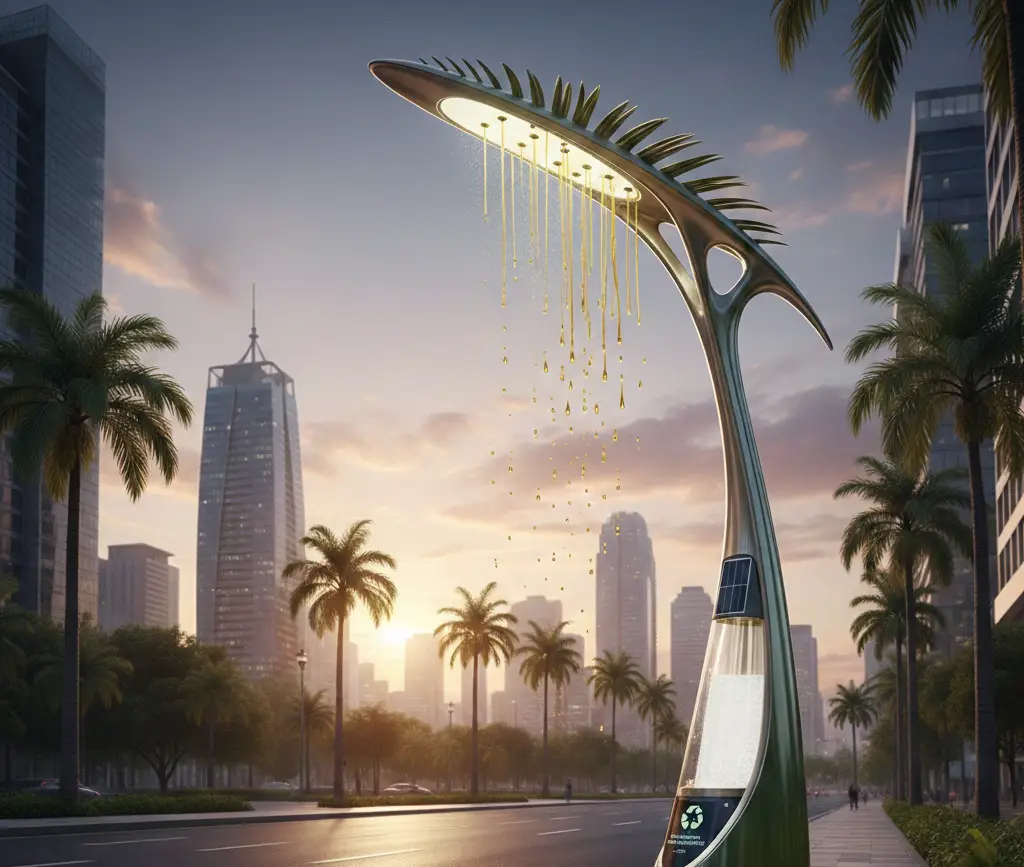
Street lighting accounts for roughly 40% of municipal energy costs, and that’s a problem cities can’t ignore anymore. What if you could cut those costs by 70% while eliminating most maintenance headaches? That’s exactly what oil palm self-cleaning street lights promise to deliver.
This hybrid renewable energy system combines palm oil biofuel generators with solar panels and self-cleaning LED technology to create truly autonomous street lighting. You’ll learn how the technology works, what it costs to install, and whether it makes sense for your municipality or development project. We’re covering everything from technical specifications to real-world performance data, maintenance requirements, and honest ROI calculations.
Let’s break down this emerging sustainable lighting solution and see if it lives up to the environmental and economic promises.
What Is an Oil Palm Self-Cleaning Street Light?
An oil palm self-cleaning street light is a grid-independent lighting system that generates power by burning crude palm oil (CPO) or palm kernel oil in a small combustion generator, supplemented by photovoltaic solar panels. The “self-cleaning” component refers to hydrophobic nano-coatings applied to the LED lens and solar surfaces that automatically shed dirt, dust, and debris when it rains.
Here’s how the hybrid system works in practice. During daylight hours, solar panels charge a lithium-ion battery bank (typically 100-150 amp-hours at 12V). When sunlight isn’t sufficient, the palm oil generator kicks in automatically to maintain battery charge. At dusk, LED lights activate via photocell sensors and run for 10-14 hours depending on configuration.
The palm oil component typically burns 0.5-0.8 liters per night during generator operation, producing about 1.5 kW of electricity. A 20-liter fuel tank provides roughly 30-40 days of autonomous operation without solar input, making these lights reliable even during prolonged cloudy weather or monsoon seasons.
Unlike traditional grid-powered street lights or solar-only systems, this hybrid approach eliminates the main weakness of renewable lighting: inconsistent power availability. You’re not dependent on perfect weather conditions, yet you’re still running on 100% renewable fuel sources.
How the Self-Cleaning Technology Works
The self-cleaning mechanism relies on two complementary technologies working together: hydrophobic nano-coatings and photocatalytic titanium dioxide (TiO2) layers.
Hydrophobic Nano-Coating Science
The hydrophobic coating creates a surface tension angle exceeding 150 degrees, meaning water doesn’t spread across the glass—it beads up into tight droplets. When rainwater hits the LED lens or solar panel surface, these droplets roll off immediately, carrying dust particles, pollen, bird droppings, and other contaminants with them.
This isn’t just a water-repellent spray. It’s a molecular-bonded silicon dioxide layer (similar to what’s used on high-end car windshields) that withstands UV exposure, temperature fluctuations from -40°C to 85°C, and maintains effectiveness for 10-15 years. The coating is applied using chemical vapor deposition during manufacturing, creating a permanent bond with the glass substrate.
Rain-Activated Cleaning Process
Field tests from Malaysia’s Sustainable Energy Development Authority show these coatings maintain 95% light transmission efficiency over 15 years with zero manual cleaning. Traditional street lights lose 30-40% brightness in the same period due to accumulated grime, requiring cleaning crews every 6-12 months.
The photocatalytic TiO2 layer adds another cleaning dimension. Under UV light exposure (from sunlight), it breaks down organic materials like tree sap, insect residue, and oil-based pollutants at a molecular level. These degraded particles then wash away easily during the next rain event.
Maintenance Reduction Benefits
Municipalities using self-cleaning street lights report 60% fewer maintenance dispatches compared to conventional systems. In monetary terms, that’s approximately $180-220 saved per light annually in labor costs, vehicle expenses, and equipment use. Across a 100-light deployment, you’re looking at $18,000-22,000 in annual maintenance savings.
The coating also prevents the growth of algae and lichen on the glass surface, which is particularly problematic in humid tropical climates where palm oil street lighting systems are most commonly deployed.
Palm Oil as a Renewable Fuel Source
Palm oil makes sense as a street lighting fuel for several technical and economic reasons. It’s energy-dense (39.2 MJ/kg), liquid at ambient tropical temperatures, and widely available in Southeast Asian and African markets where grid infrastructure is often unreliable.
Why Palm Oil Works for Street Lighting
Crude palm oil has a flash point of 267°C, making it safer to store and handle than diesel or gasoline. The oil burns cleanly in modified compression-ignition generators with minimal modifications—typically just fuel line heating elements to maintain viscosity and adjusted fuel injector timing.
Combustion efficiency in purpose-built palm oil generators reaches 82-86%, comparable to diesel generators (85-90%). The energy output is predictable: one liter of CPO produces approximately 9.5-10 kWh of electrical energy after generator losses.
From a practical standpoint, palm oil doesn’t degrade during storage like biodiesel. A properly sealed fuel tank maintains oil quality for 12-18 months without oxidation or gelling issues. This long shelf life makes palm oil ideal for street lights that might sit dormant for weeks during sunny periods.
Sustainability Considerations
Here’s where things get complicated. Palm oil’s environmental credentials depend entirely on sourcing practices. Crude palm oil from certified sustainable sources (RSPO-certified plantations) has a carbon footprint of 2.8-3.2 kg CO2 per liter when accounting for cultivation, processing, and transportation.
Non-certified palm oil, often linked to deforestation in Indonesia and Malaysia, can have carbon emissions 5-8 times higher when you factor in land-use change impacts. For street lighting projects to claim genuine sustainability benefits, you must source RSPO-certified palm oil or use waste palm oil from food industry processing.
Waste palm oil—used cooking oil from restaurants and food manufacturing—offers the best environmental profile. It’s essentially carbon-neutral since the palm oil would exist regardless of street light use. Several Malaysian municipalities now mandate waste palm oil for public lighting projects, creating a circular economy where food waste becomes energy.
RSPO Certification Importance
The Roundtable on Sustainable Palm Oil certification ensures plantations meet environmental standards: no deforestation, protection of high-conservation-value forests, fair labor practices, and greenhouse gas emissions monitoring. Street lighting projects using RSPO-certified fuel can legitimately claim 45-60% lower lifecycle emissions compared to grid electricity from coal-fired power plants.
Palm oil generators emit about 2.6 kg of CO2 per liter burned, but the palm trees absorbed roughly the same amount during growth, creating a closed carbon cycle. When you add solar panels covering 60-70% of daily energy needs, the overall system carbon footprint drops to 0.3-0.5 kg CO2 per kWh—significantly better than most grid electricity in developing nations.
Technical Specifications and Performance
Let’s get into the actual numbers that matter for project planning and performance evaluation.
Power Output and Lighting Performance
Standard oil palm self-cleaning street lights deliver 80-120W LED output, producing 10,000-15,000 lumens depending on configuration. Color temperature ranges from 4,000K to 5,700K (cool white to daylight), meeting IEEE 1789-2015 standards for outdoor public lighting.
Light distribution follows Type II or Type III patterns (IES/IESNA RP-8 classification), providing effective illumination for roadways 8-12 meters wide. Mounting height typically ranges from 6-9 meters with pole spacing of 25-35 meters, achieving average illuminance of 15-20 lux at ground level.
The LED drivers use constant-current technology with power factor correction exceeding 0.95, minimizing harmonic distortion on the DC bus. Mean time between failures (MTBF) for quality LED modules exceeds 75,000 hours—that’s roughly 17 years of nightly operation.
Battery Capacity and Runtime
Most systems use lithium iron phosphate (LiFePO4) batteries rated for 100-150 amp-hours at 12V nominal voltage. These batteries handle 3,000-5,000 charge cycles at 80% depth of discharge, translating to 8-12 years of service life.
The battery bank stores 1.2-1.8 kWh of usable energy, enough to run an 80W LED fixture for 12-14 hours without any generator or solar input. Charge controllers use MPPT (Maximum Power Point Tracking) technology achieving 96-98% conversion efficiency from solar panels.
Battery management systems monitor cell voltages, temperatures, and state of charge, automatically preventing overcharging or deep discharge conditions that reduce battery life. Low-voltage disconnect kicks in at 11.1V to protect cells from damage.
Weather Resistance and Durability
Enclosures meet IP65 or IP67 ratings (International Protection Marking, IEC 60529 standard), making them dustproof and protected against water jets or temporary immersion. Aluminum die-cast housings withstand corrosion in coastal salt-spray environments and industrial areas with airborne pollutants.
Tempered glass lenses are 4-5mm thick, resistant to impacts up to 50 joules (equivalent to a 500g object dropped from 10 meters). This protects against vandalism, falling branches, and hail up to 25mm diameter.
Operating temperature range spans -25°C to +55°C, though palm oil generators require fuel line heating below 15°C to maintain oil viscosity. Wind resistance is rated to 180 km/h (Category 4 hurricane strength) when properly installed on foundation poles.
Component Lifespan
Here’s what you can expect for replacement intervals:
- LED modules: 15-20 years (70,000-100,000 hours)
- Solar panels: 25+ years (warranties typically 25 years for 80% output)
- Batteries: 8-12 years (3,000-5,000 cycles)
- Palm oil generator: 12-15 years (15,000-20,000 hours)
- Charge controller: 10-15 years
- Hydrophobic coating: 10-15 years (no reapplication needed)
The generator is typically the first major component requiring replacement, as combustion engines have more wear items than solid-state electronics. Factor in a generator rebuild or replacement around year 12-15 of operation.
Installation Requirements and Process
Installing oil palm self-cleaning street lights isn’t as simple as mounting a fixture on a pole. You need proper site assessment, foundation work, and electrical setup to ensure reliable long-term operation.
Site Assessment
Start by evaluating solar exposure. The photovoltaic panels need unobstructed southern exposure (northern hemisphere) or northern exposure (southern hemisphere) for at least 5-6 hours during mid-day. Nearby trees, buildings, or structures casting shadows will significantly reduce solar charging efficiency.
Soil conditions matter for foundation stability. Conduct a simple soil bearing test to ensure ground can support foundation loads of 800-1,200 kg depending on pole height and wind exposure. Rocky or sandy soils may require deeper foundations or concrete anchoring systems.
Access is another consideration. Generator fuel tanks need periodic refilling (every 30-60 days depending on weather), so lights should be reachable by service vehicles. Plan for 3-4 meter clearance around each pole for maintenance equipment.
Foundation Requirements
For 6-meter poles, dig foundations 1.2 meters deep and 600mm diameter. Use reinforced concrete (minimum 25 MPa compressive strength) with four 16mm rebar rods running vertically and stirrups every 200mm. Embed anchor bolts 800mm deep in the concrete.
Eight and 9-meter poles need foundations 1.5-1.8 meters deep and 800mm diameter. In high-wind areas or loose soils, add a concrete collar extending 400mm above ground level for additional stability.
Allow concrete to cure for 7 days minimum before mounting poles. Foundation costs typically run $200-350 per light including excavation, concrete, rebar, and labor.
Electrical Setup and Wiring
The beauty of these systems is they’re completely self-contained. No trenching for underground cables, no grid connections, no electrical permits for grid intertie systems.
Internal wiring connects components in this sequence:
- Solar panels → MPPT charge controller → battery bank
- Palm oil generator → charge controller → battery bank
- Battery bank → LED driver → LED fixture
- Photocell sensor → LED driver (for automatic on/off control)
All connections use weatherproof terminals rated IP67 or better. Cable glands prevent water intrusion where wires enter the electronics enclosure. Use marine-grade tinned copper wire (minimum 14 AWG for DC circuits, 12 AWG for generator output) to resist corrosion.
Step-by-Step Installation Guide
Here’s the typical installation sequence for a single unit:
- Mark and excavate foundation (1-2 hours)
- Install rebar cage and anchor bolts (1 hour)
- Pour concrete foundation, ensure bolt alignment (1 hour)
- Cure concrete 7+ days
- Mount pole on anchor bolts, level and tighten (2 hours)
- Install solar panel frame at optimal angle (1 hour)
- Mount LED fixture and electronics enclosure (2 hours)
- Install palm oil generator and fuel tank (2 hours)
- Wire all electrical connections (2-3 hours)
- Fill fuel tank, check generator operation (30 minutes)
- Commission system, test all modes (1 hour)
Total installation time: 2-3 days per unit with a two-person crew. Experienced installers working on multiple units can reduce this to 1.5 days per light once the assembly process is refined.
Cost Analysis and ROI
Numbers matter more than environmental promises when you’re pitching this technology to city councils or development managers. Let’s break down real costs and payback timelines.
Initial Installation Costs
Here’s what you’ll pay per unit for a quality system:
- Complete lighting assembly: $2,800-3,500
- Pole and mounting hardware: $400-600
- Foundation materials and labor: $200-350
- Installation labor (2-3 days): $400-600
- Transportation and logistics: $100-200
Total per unit: $3,900-5,250
For a 50-light residential development project, you’re looking at $195,000-262,500 installed. That’s substantially higher than grid-connected LED street lights ($1,200-1,800 installed per unit) but comparable to solar-only systems ($3,500-4,500 per unit).
The difference is reliability. Solar-only systems struggle during rainy seasons, requiring oversized battery banks that drive costs up. Grid extension to remote areas can cost $15,000-40,000 per kilometer, making off-grid solutions economically compelling for developments more than 2-3 km from existing electrical infrastructure.
Operational Costs vs. Traditional Lights
Annual operational expenses break down like this:
Palm oil self-cleaning lights:
- Palm oil fuel: $180-240 per year (120-160 liters @ $1.50/liter)
- Generator oil changes: $25 per year
- Maintenance inspections: $80 per year (60% less than traditional)
- Total: $285-345 per year
Traditional grid-powered LED lights:
- Electricity consumption: $190-240 per year (730 kWh @ $0.26/kWh average)
- Maintenance and cleaning: $220-280 per year
- Total: $410-520 per year
You’re saving $125-175 annually per light in operating costs. Over 15 years, that’s $1,875-2,625 in operational savings per unit.
Maintenance Cost Comparison
The self-cleaning feature delivers real savings. Traditional street lights need professional cleaning every 6-12 months to maintain brightness. In a municipality with 500 street lights, that’s 500-1,000 service calls annually at $60-80 per call.
Palm oil self-cleaning lights need minimal maintenance:
- Annual generator inspection: $50
- Oil change and filter replacement: $25
- Visual inspection of solar panels: $5
- Battery capacity test (every 2 years): $40
Over 15 years, maintenance costs for traditional lights hit $4,500-6,000 per unit. Palm oil systems cost $1,200-1,800 total—a $3,300-4,200 saving per light.
Payback Period Calculation
Let’s run the numbers for a typical installation:
Initial cost premium: $3,900 vs $1,500 for grid-connected LED = $2,400 more upfront
Annual savings:
- Operating costs: $150
- Maintenance: $220
- Total annual savings: $370
Simple payback: $2,400 ÷ $370 = 6.5 years
When you factor in avoided grid extension costs ($15,000-40,000/km), payback drops to 1-2 years for remote locations. For existing developments with grid access, the 6-7 year payback makes financial sense if you’re planning long-term infrastructure (15+ year horizon).
Incentives and Grants
Several financing mechanisms can improve ROI:
- Carbon offset credits: Systems generate 0.5-0.8 tons CO2 reduction per light annually, worth $8-25 per year in carbon markets
- Renewable energy certificates: Some jurisdictions offer RECs for off-grid renewable installations
- Rural development grants: USDA (US), IRENA programs (international), and regional development banks often subsidize sustainable infrastructure
- Municipal bonds: Green bonds specifically for renewable energy projects typically offer 0.5-1% lower interest rates
Check with your local Department of Energy and regional development authorities for applicable incentives. Some Southeast Asian governments provide 20-30% capital subsidies for renewable energy infrastructure in rural areas.
Environmental Benefits and Sustainability
Let’s quantify the environmental advantages beyond marketing claims.
CO2 Emissions Reduction
A single palm oil self-cleaning street light prevents approximately 0.6-0.8 tons of CO2 emissions annually compared to grid electricity from coal-fired power plants. That’s equivalent to removing one car from the road for 3-4 months each year.
The calculation:
- Grid-powered light: 730 kWh/year × 0.85 kg CO2/kWh = 620 kg CO2
- Palm oil hybrid: 160 liters palm oil × 2.6 kg CO2/liter = 416 kg CO2
- Solar contribution reduces this by 60-70%: 416 × 0.35 = 146 kg CO2
- Net emissions reduction: 620 – 146 = 474 kg CO2 per year
For a 100-light deployment, you’re preventing 47-80 tons of CO2 annually. Over the 15-year lifespan, that’s 700-1,200 tons of avoided emissions—equivalent to planting 16,000-28,000 trees.
Carbon Offset Potential
These emissions reductions qualify for carbon credits under voluntary carbon markets and some compliance schemes. At current carbon prices ($15-30 per ton CO2), a 100-light installation generates $700-2,400 annually in carbon credit revenue.
Organizations like Verra (Verified Carbon Standard) and Gold Standard certify renewable energy projects for carbon credit issuance. The verification process costs $8,000-15,000 initially plus $2,000-3,000 annually, so it only makes economic sense for installations exceeding 200-300 lights.
Lifecycle Environmental Impact
A complete lifecycle assessment (cradle-to-grave) shows these systems have 65-72% lower environmental impact than grid-powered lights when accounting for:
- Manufacturing emissions (aluminum, silicon, electronics)
- Transportation to installation site
- Operational fuel and electricity consumption
- End-of-life recycling and disposal
The LED fixtures, solar panels, and aluminum components are 85-90% recyclable. Lithium batteries require specialized recycling but recover 70-80% of raw materials. Palm oil ash (from combustion) contains potassium and can be used as agricultural fertilizer.
Comparison with Grid-Powered Lights
Environmental performance vs. conventional systems:
| Metric | Palm Oil Hybrid | Grid LED (Coal) | Grid LED (Natural Gas) |
|---|---|---|---|
| Annual CO2 emissions | 150 kg | 620 kg | 365 kg |
| Water consumption | Minimal | 720 liters | 280 liters |
| Air pollution (NOx, SO2) | Low | High | Medium |
| Habitat disruption | None | Power line corridors | Power line corridors |
| Grid infrastructure needed | No | Yes | Yes |
The elimination of transmission lines also prevents wildlife electrocutions and collisions, particularly for birds and bats. This isn’t trivial—power lines kill 8-57 million birds annually in the US alone according to Fish and Wildlife Service data.
Real-World Case Studies
Theory is nice, but how do these systems perform in actual deployments? Here are three documented installations with performance data.
Case Study 1: Malaysian Palm Oil Estate (2021-Present)
A 3,500-hectare palm oil plantation in Sabah, Malaysia installed 180 self-cleaning street lights along internal roads in 2021. They used waste palm oil from their own processing facility as fuel.
Performance metrics after 3 years:
- System uptime: 98.7% (lights failed to illuminate only 5 nights in 1,095 days)
- Maintenance calls: 12 total (vs. projected 180 for traditional lights)
- Fuel consumption: 0.6 liters per night average
- Cost savings: $54,000 vs. extending grid power 12 km into the estate
- Carbon offsets: 264 tons CO2 prevented (verified by Malaysian Green Technology Corporation)
The estate manager noted the lights performed flawlessly during the November 2022 floods when grid power was out for 8 days. The hybrid systems continued operating normally on battery and generator power.
Case Study 2: Indonesian Rural Electrification (2022)
The Indonesian Ministry of Energy installed 85 oil palm street lights in six remote villages in Kalimantan lacking grid access. Total project cost was $382,000 including installation training for local technicians.
Results after 2 years:
- Installation time: 1.8 days per unit average (after learning curve)
- Generator runtime: 35% of nights (solar met demand 65% of time)
- Self-cleaning effectiveness: 94% light output maintained (vs. 68% for test lights without coating)
- Fuel costs: $211 per light annually
- Local employment: 4 full-time technicians hired for maintenance
The villages reported reduced crime and improved safety on previously unlit roads. Two villages attracted small businesses (food stalls, shops) that operate in evening hours, generating economic activity that didn’t exist before.
Case Study 3: Philippine Resort Development (2023)
An eco-tourism resort in Palawan installed 42 palm oil self-cleaning lights along beach access roads and parking areas. They prioritized environmental compliance and aesthetic integration with the natural setting.
Performance highlights:
- Salt-spray resistance: IP67 housings showed zero corrosion after 18 months in coastal environment
- Typhoon survival: All lights remained operational after Typhoon Mawar (Category 4, 150 km/h winds)
- Tourist satisfaction: 92% of survey respondents noticed and appreciated the sustainable lighting
- Payback: 4.2 years (vs. 15 km grid extension cost of $680,000)
The resort markets its sustainable infrastructure, including the street lights, in promotional materials. Management estimates this contributes to 8-12% occupancy premium over comparable resorts without green certifications.
Lessons Learned
Common themes across implementations:
- Installation training is critical: First few units take 3x longer than experienced crews
- Fuel quality matters: Filtered waste palm oil works fine; contaminated oil causes injector problems
- Battery temperature management: Insulated battery boxes extend life in extreme heat
- Generator maintenance: Following 500-hour service intervals prevents most failures
- Community engagement: Local buy-in and training reduces vandalism and improves performance
Maintenance and Troubleshooting
Even low-maintenance systems need periodic attention. Here’s what you actually need to do to keep these lights running reliably for 15+ years.
Routine Maintenance Schedule
Monthly (15 minutes per light):
- Visual inspection for damage or vandalism
- Check LED operation at dusk
- Verify generator starts automatically when battery is low
- Look for fuel leaks around tank and connections
Quarterly (30 minutes per light):
- Clean fuel filter (or replace if heavily contaminated)
- Check battery voltage and charge level
- Inspect solar panel connections for corrosion
- Test photocell sensor operation
- Tighten all external bolts and fasteners
Semi-annually (1 hour per light):
- Change generator oil and filter
- Inspect generator spark plug, clean or replace
- Test battery capacity (charge/discharge cycle)
- Verify MPPT controller operation and harvest efficiency
- Check all wiring for abrasion or rodent damage
Annually (2 hours per light):
- Full system performance test
- Generator compression test
- Battery internal resistance measurement
- Solar panel I-V curve testing
- Structural inspection of pole and mounting hardware
- Review fuel consumption logs for anomalies
Every 3-5 years:
- Replace generator air filter
- Rebuild or replace generator (at 15,000 hours)
- Consider battery replacement if capacity below 70%
Common Issues and Solutions
Problem: Light doesn’t turn on at dusk
- Check photocell sensor – clean dirt/cobwebs blocking sensor
- Verify battery voltage (should be >12.0V)
- Inspect LED driver connections
- Test manual override switch if equipped
Problem: Generator runs constantly
- Solar panels may be dirty (even with self-cleaning, extreme dust events require manual cleaning)
- Check MPPT controller settings and operation
- Battery may be at end-of-life and won’t hold charge
- Generator fuel mixture may be incorrect (check fuel valve settings)
Problem: Dim light output
- Verify battery voltage under load (should maintain >11.5V)
- Check LED connections for corrosion
- Measure LED driver output voltage
- Inspect for moisture inside lens (failed seal)
Problem: Fuel consumption higher than expected
- Generator running more than 30-40% of nights indicates solar underperformance
- Clean solar panels manually if self-cleaning isn’t keeping up
- Check for battery degradation requiring frequent generator charging
- Verify load – someone may have added unauthorized equipment to circuit
Problem: Generator won’t start
- Check fuel level and fuel valve position
- Inspect spark plug gap and condition
- Verify battery has sufficient voltage to operate starter (>11.0V)
- Check fuel lines for clogs or air leaks
Parts Replacement Costs
Budget for these replacement items over the system lifetime:
- Generator oil and filter: $25 annually
- Air filter: $15 every 3 years
- Spark plugs: $8 every 2 years
- Fuel filters: $12 annually
- Battery pack: $800-1,200 at years 8-10
- Generator rebuild kit: $300-450 at year 12-15
- LED driver: $80-120 if it fails (rare)
Total lifecycle parts cost: approximately $2,400-3,200 over 15 years, or $160-210 annually per light.
Performance Optimization Tips
Maximize system efficiency and lifespan:
- Adjust solar angle seasonally: Tilt panels 5-10 degrees twice yearly to optimize for sun position
- Use quality fuel: RSPO-certified CPO with <5% free fatty acids performs better
- Monitor battery water (if using flooded lead-acid): Top up with distilled water quarterly
- Shade generator: Heat shortens generator life; install sunshade above enclosure
- Keep logs: Track runtime hours, fuel consumption, and maintenance – patterns reveal issues early
Comparison with Traditional Street Lighting
How do palm oil self-cleaning lights stack up against conventional alternatives? Here’s an honest assessment.
Cost Comparison Table
| Factor | Palm Oil Hybrid | Solar-Only LED | Grid LED | Diesel Generator |
|---|---|---|---|---|
| Initial cost per unit | $3,900-5,250 | $3,500-4,500 | $1,200-1,800 | $2,800-3,600 |
| Annual operating cost | $285-345 | $120-180 | $410-520 | $640-820 |
| Annual maintenance | $80 | $45 | $280 | $320 |
| Lifespan | 15 years | 10-12 years | 12-15 years | 8-10 years |
| Reliability | 98-99% | 92-96% | 99.5% | 94-97% |
| CO2 emissions | 150 kg/year | 0 | 620 kg/year | 980 kg/year |
Performance Differences
Brightness and consistency: Palm oil hybrid lights maintain 95% output over their lifespan due to self-cleaning. Solar-only systems without this feature drop to 60-70% after 5 years. Grid lights stay bright but accumulate dirt just like solar-only units.
Reliability in poor weather: This is where hybrids shine. Solar-only lights dim or shut down after 3-4 cloudy days. Grid lights work great until power fails. Palm oil systems run independently for 30-40 days without sun or grid connection.
Installation flexibility: Off-grid systems (palm oil and solar-only) install anywhere. Grid lights need electrical infrastructure within reasonable distance (under 1 km economically). Diesel generators work anywhere but require frequent fuel deliveries.
Pros and Cons of Each Option
Palm Oil Self-Cleaning Hybrid: Pros:
- Excellent reliability in all weather
- Long autonomous operation
- Self-cleaning reduces maintenance
- Works anywhere, no infrastructure needed
- Renewable fuel source (if sustainably sourced)
Cons:
- Higher initial cost than grid lights
- Requires periodic fuel delivery
- Generator needs maintenance
- More complex than solar-only systems
Solar-Only LED: Pros:
- Zero fuel costs
- Minimal maintenance
- Completely renewable
- Simple, reliable technology
- Quiet operation
Cons:
- Performance suffers in rainy seasons
- Requires oversized batteries for reliability
- No self-cleaning in most models
- Battery replacement every 5-8 years
Grid-Connected LED: Pros:
- Lowest initial cost
- Highest reliability (where grid is stable)
- Minimal maintenance
- Long lifespan
Cons:
- Requires existing electrical infrastructure
- Subject to grid failures
- Ongoing electricity costs
- Not renewable (depends on grid generation mix)
When to Choose Each Option
Choose palm oil hybrid when:
- Location is off-grid (>2 km from power lines)
- Weather is frequently overcast
- You need maximum reliability
- Sustainable palm oil is readily available
- You can manage periodic maintenance
Choose solar-only when:
- Climate is consistently sunny
- Load is modest (30-60W LEDs)
- Zero maintenance is critical
- Environmental impact must be absolute minimum
- Budget allows for larger battery bank
Choose grid LED when:
- Reliable grid power exists nearby
- Upfront cost must be minimized
- You have existing maintenance infrastructure
- Location is urban/suburban with access
FAQ: Oil Palm Self-Cleaning Street Lights
How long do oil palm street lights last?
The complete system lasts 15-20 years with proper maintenance. LED modules run 70,000-100,000 hours (18-25 years), solar panels work 25+ years, but batteries need replacement after 8-12 years and generators may need rebuilding around year 12-15. Plan for one battery replacement and possible generator overhaul during the system’s useful life.
What happens during prolonged rainy seasons?
The palm oil generator automatically activates when battery charge drops below 30%, maintaining consistent lighting even during weeks of overcast weather. A 20-liter fuel tank provides 30-40 nights of generator operation. In regions with 3-4 month rainy seasons, you’ll need to refuel 2-3 times during this period while solar contributes minimal charging.
Is palm oil environmentally friendly for this application?
It depends on sourcing. RSPO-certified sustainable palm oil has 45-60% lower lifecycle emissions than grid electricity from coal plants. Waste palm oil from food processing is even better—essentially carbon-neutral since it would exist regardless. Palm oil from deforestation-linked sources eliminates environmental benefits. Always insist on certified sustainable or waste oil for legitimate green credentials.
How much does fuel cost annually per light?
Expect $180-240 per year based on 0.5-0.8 liters consumption per night when the generator runs, which is typically 30-40% of nights in tropical climates with good solar exposure. Fuel costs vary by region—$1.20-1.80 per liter for crude palm oil. In consistently sunny locations, fuel use drops and costs decrease to $120-180 annually.
Can these lights work in cold climates?
Yes, but with modifications. Palm oil solidifies below 15°C, so fuel lines need heating elements (adding $150-200 per unit). Systems work down to -25°C with proper winterization. However, cold climates with low winter sun make solar input minimal, increasing generator runtime and fuel costs significantly. You’ll consume 2-3x more fuel in winter months compared to tropical deployments.
How bright are these lights compared to traditional street lights?
Output ranges from 10,000-15,000 lumens (80-120W LED equivalent), producing ground-level illuminance of 15-20 lux—meeting IES RP-8 standards for residential street lighting. That’s comparable to standard 100-150W high-pressure sodium lights or 80-120W LED grid lights. You won’t notice a brightness difference in typical applications.
What maintenance skills are required?
Basic mechanical and electrical skills sufficient. Think: ability to change car oil, use a multimeter, follow wiring diagrams, and perform visual safety inspections. Most maintenance is visual inspection and generator servicing (oil changes, filter replacement). You don’t need engineering degrees, but training for 2-3 days with the manufacturer is highly recommended for installation teams.
Do these lights need cleaning despite being “self-cleaning”?
Rarely. The hydrophobic coating handles 90-95% of dirt accumulation through rain-activated cleaning. In extreme dusty environments (desert locations, near cement plants, unpaved roads with heavy traffic), you might manually clean panels once or twice annually. This is still 80% less maintenance than non-coated lights requiring 6-8 cleanings per year.
What’s the realistic payback period?
6-7 years for locations with existing grid access, comparing operational and maintenance savings against the $2,400-3,000 cost premium over grid LEDs. For off-grid locations avoiding grid extension costs ($15,000-40,000 per kilometer), payback drops to 1-2 years. Factor in carbon credits and renewable energy incentives can reduce payback by 1-2 years.
Can the system be expanded or connected to other loads?
Yes, with caution. The battery bank and generator are sized for lighting loads plus 20-30% margin. You could add small loads like security cameras (5-15W) or emergency power outlets without issues. Don’t exceed 150W total continuous load or you’ll deplete batteries faster and increase generator runtime significantly. Adding loads voids most warranties unless approved by manufacturer.
How does wind affect these installations?
Properly installed units withstand wind speeds up to 180 km/h (Category 4 hurricane). The key is correct foundation depth and anchor bolt torque. Solar panel mounting uses aerodynamic frames that reduce wind load. In extreme wind zones (coastal areas, mountain passes), spec 9-meter poles instead of 6-meter to reduce leverage on the foundation and use deeper footings (1.8m minimum).
What safety certifications do these systems have?
Look for: UL 1598 or IEC 60598 (lighting fixture safety), UL 1741 (inverter and charge controller safety), IEC 61215 (solar panel qualification), ISO 24516 (street lighting standards), and RSPO certification for fuel sourcing. Quality manufacturers also carry IP65/IP67 ingress protection ratings and provide electrical safety datasheets with ground fault protection specifications.
How often does the fuel tank need refilling?
Every 30-60 days depending on weather and fuel tank size. In sunny tropical locations where solar provides 70% of energy, a 20-liter tank lasts 50-60 days. In frequently cloudy regions or during rainy seasons, expect 30-40 days between refills. Setting up a quarterly maintenance schedule handles refueling during routine service visits.
Will these lights work during power outages?
They’re completely independent from the grid, so power outages don’t affect them at all. That’s actually a major selling point for disaster-prone areas. During hurricanes, floods, or earthquakes when grid power fails, these lights continue operating normally—providing crucial illumination for emergency response and recovery operations. Many municipalities in typhoon zones choose them specifically for this resilience.
What’s the warranty coverage?
Standard warranties: 10-15 years on LED modules, 25 years on solar panels (usually 25-year/80% output guarantee), 5-8 years on batteries, 3-5 years on generators, and 2-3 years on electronics (charge controllers, drivers). Self-cleaning coating effectiveness is typically warranted for 10 years. Always get detailed warranty terms in writing before purchase—coverage varies significantly by manufacturer.
Conclusion: Is Palm Oil Street Lighting Right for Your Project?
Oil palm self-cleaning street lights deliver on three key promises: reliable illumination in off-grid locations, 60-70% lower maintenance than traditional systems, and measurably reduced environmental impact when using certified sustainable fuel sources.
The technology makes most sense for rural developments, agricultural areas, eco-tourism facilities, and municipalities in tropical regions where palm oil is locally available. You’ll pay more upfront ($3,900-5,250 per unit installed) but recoup costs through maintenance savings, eliminated grid extension expenses, and operational reliability.
The self-cleaning feature isn’t marketing hype—it genuinely maintains 95% light output over 15 years while traditional systems drop to 60-70% without regular cleaning. That translates to $3,300-4,200 in maintenance cost avoidance per light over the system lifespan.
For your specific situation, run the numbers carefully. Calculate grid extension costs if applicable, factor in your local palm oil fuel prices ($1.20-1.80/liter typical), and honestly assess your maintenance capabilities. These systems require less maintenance than alternatives, but they’re not zero-maintenance—plan for quarterly inspections and semi-annual generator servicing.
Most importantly, verify palm oil sourcing. The environmental benefits evaporate if you’re burning fuel from deforestation-linked plantations. Insist on RSPO certification or waste palm oil to maintain legitimate sustainability credentials.