You just got four new tires. You’re back on the road, cruising home—then that little TPMS warning light stares you down from the dashboard. You’ve inflated everything to the right PSI. Nothing’s wrong. So why won’t it turn off?
This is the most common TPMS frustration, and a TPMS relearn tool is usually all you need to fix it. Whether you installed new sensors, rotated your tires, or swapped wheels, the vehicle’s ECU simply doesn’t recognize the new sensor IDs yet—and a relearn procedure syncs everything back up.
This guide covers every option: the best TPMS tools on the market, step-by-step relearn procedures, and—critically—how to reset and activate sensors without any tool at all, if your vehicle allows it. By the end, you’ll know exactly what to do.
What Is a TPMS Relearn Tool?
TPMS stands for Tire Pressure Monitoring System. The NHTSA (National Highway Traffic Safety Administration) mandated it on all U.S. passenger vehicles manufactured after September 2007 under the TREAD Act (Transportation Recall Enhancement, Accountability, and Documentation Act). If your car was built after that date, it has one.
A TPMS relearn tool is a device that communicates with each wheel’s pressure sensor, reads its unique sensor ID, and registers that ID with the vehicle’s ECU (Engine Control Unit). Without this step, the ECU doesn’t know which sensor is in which position—or even that a new sensor exists.
You need a relearn procedure after: rotating your tires, installing new OEM or aftermarket sensors, swapping to a winter wheel set, or replacing a single damaged sensor. Skip the relearn, and that warning light stays on—even if everything’s mechanically perfect.
Direct TPMS vs. Indirect TPMS: Key Difference
Direct TPMS uses physical sensors inside each wheel (mounted on the valve stem) that transmit live pressure data at either 315 MHz or 433 MHz depending on the vehicle. These sensors have batteries, sensor IDs, and need relearn procedures after replacement.
Indirect TPMS uses the ABS wheel speed sensors already on your car to detect pressure loss by monitoring rotational differences between tires. No physical pressure sensors—just software. Most indirect systems reset through driving or a button press, no specialized tool required.
Most modern vehicles use direct TPMS. If your car has physical sensors with batteries (check the valve stem—if it’s heavier than a standard stem, it’s a sensor), you’ll likely need a relearn tool at some point.
Types of TPMS Tools Explained
TPMS Relearn Tool
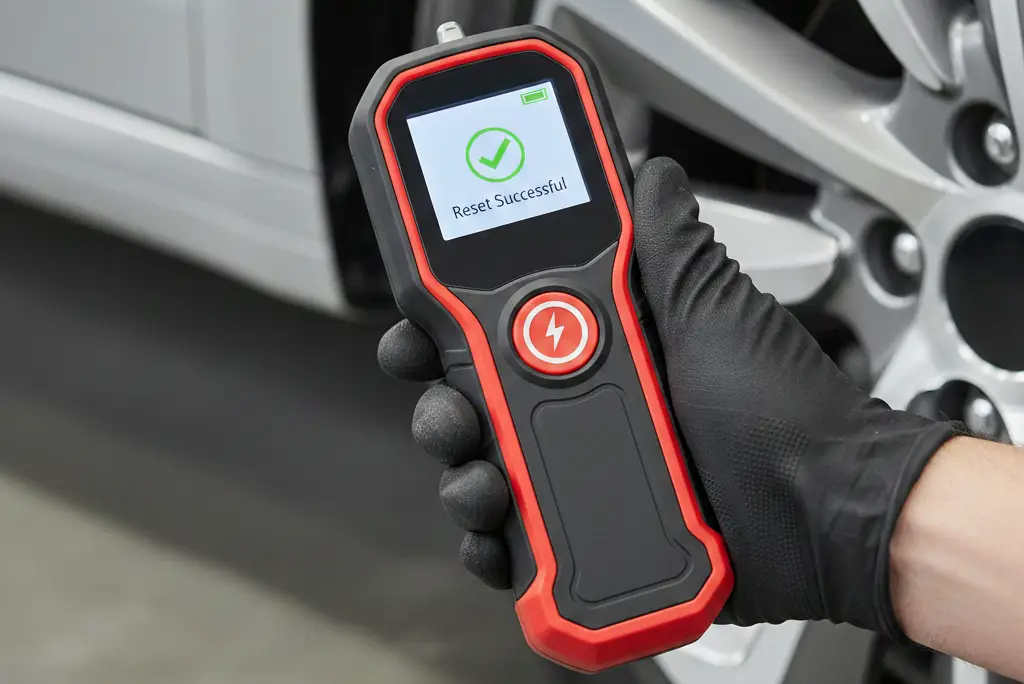
A dedicated TPMS relearn tool triggers each sensor to broadcast its ID, then registers that ID to the vehicle’s ECU. This is the tool most DIYers and tire shops need for everyday work. It doesn’t read live data or program new sensor IDs—it just handles the relearn sequence.
Best for: post-rotation relearns, OEM sensor replacements, seasonal wheel swaps.
Example: Autel MaxiTPMS TS408, ~$60. Covers most U.S. vehicles 2006 and newer.
TPMS Reset Tool
A TPMS reset tool is a simpler device—often OBD-II based—that clears the TPMS warning light and resets the system’s pressure baseline. It doesn’t actually communicate with the sensors; it just tells the ECU to stop complaining.
Best for: situations where you’ve inflated tires correctly but the light won’t reset on its own.
Example: Basic OBD-II TPMS reset adapters, ~$20–$40. Limited functionality—won’t help if sensors need relearning.
TPMS Scan Tool
A TPMS scan tool reads live data from each sensor: tire pressure, temperature, sensor ID, battery voltage, and status. It’s a diagnostic tool—it tells you what’s wrong but doesn’t necessarily fix it. Many scan tools also include relearn functionality.
Best for: diagnosing faulty sensors, checking battery life, identifying which sensor is throwing a code.
Example: Autel MaxiTPMS TS508, ~$150. Reads all sensor data and supports relearn for 95%+ of vehicles.
TPMS Programming Tool
A TPMS programming tool goes further than a relearn tool. It can write new sensor IDs onto aftermarket or universal sensors, effectively cloning or creating new sensor data. This is essential when installing universal TPMS sensors (like Schrader EZ-sensor or Continental VDO), which ship unprogrammed.
Examples: Autel MaxiTPMS TS608 (~$300), ATEQ VT56 (~$400), Bartec Tech600 (~$500). These are shop-grade tools used by tire professionals and dealerships.
Key distinction: A relearn tool syncs existing sensors to the ECU. A programming tool writes new IDs onto blank sensors. You need the programming tool first if you’re installing universal sensors—then a relearn second.
Best TPMS Tools: Quick Comparison
| Tool Name | Type | Price | Best For | Compatibility |
| Autel MaxiTPMS TS408 | Relearn | ~$60 | DIY after tire rotation or sensor swap | Most U.S. vehicles 2006+ |
| Autel MaxiTPMS TS508 | Scan + Relearn | ~$150 | Diagnostics and relearn in one | 95%+ of vehicles on road |
| Autel MaxiTPMS TS608 | Programming | ~$300 | Programming universal sensors | Full OBD-II support, all major brands |
| ATEQ VT56 | All-in-one | ~$400 | Professional tire shops | Professional-grade, 98%+ vehicles |
| Bartec Tech600 | Programming | ~$500 | OEM-level sensor programming | OEM-level coverage, dealer-grade |
| Basic OBD-II Reset | Reset only | ~$20 | Simple TPMS light reset only | Limited—indirect TPMS vehicles only |
*Prices approximate. Verify current pricing on manufacturer or retailer websites.
How to Use a TPMS Relearn Tool Step by Step
This procedure covers the most common stationary relearn method—works on the majority of GM, Ford, Chrysler, and Asian-market vehicles. Always check your specific vehicle’s service manual for variations.
⚠️ WARNING: Do NOT start the relearn procedure until all four tires are inflated to the correct PSI. Check the sticker on your driver’s door jamb—not the number on the tire sidewall. An incorrect PSI will cause the relearn to fail or register a false fault.
Prerequisites
- All four tires inflated to the PSI listed on the driver’s door jamb sticker
- Vehicle in park, ignition turned to ‘ON’ position (engine off unless tool requires otherwise)
- TPMS relearn tool fully charged or with fresh batteries
- Vehicle year, make, and model info ready to enter into the tool
Step-by-Step Relearn Procedure
- Enter your vehicle information into the tool. Select year, make, and model. The tool will confirm the correct relearn procedure—stationary or drive relearn—and the correct tire order.
- Select ‘TPMS Relearn’ mode on the tool’s menu. Some tools call this ‘Sensor Activation’ or ‘Relearn Procedure.’
- Start with the left front (LF) tire. Hold the tool’s antenna within 1–2 inches of the valve stem. Press the trigger button to activate the sensor.
- Wait for confirmation. The tool will display the sensor ID and confirm it’s been read. Your vehicle should honk once or the TPMS light should blink to confirm registration.
- Move to right front (RF), then right rear (RR), then left rear (LR). Follow the sequence exactly. Skipping or reversing tires causes the relearn to fail and sensor positions to be stored incorrectly.
- After all four sensors are read, wait for a final confirmation. Most vehicles honk twice or display ‘TPMS Learn Complete’ on the instrument cluster.
- For drive relearn vehicles: drive at 15–25 mph for 10–20 minutes without stopping. The ECU finalizes sensor positions during this drive cycle.
💡 TIP: Always start with the left front tire unless your owner’s manual specifies otherwise. GM trucks and SUVs typically follow LF → RF → RR → LR. Some Chrysler/Dodge vehicles use a different order—always confirm with your tool or manual.
How to Reset TPMS Without a Tool
Good news: not every TPMS situation requires a specialized tool. If you’ve simply inflated your tires after the light came on—and your vehicle uses indirect TPMS or a simple direct system—these methods often work.
Method 1: Drive the Vehicle (Most Common)
This is the first thing to try. Many vehicles—especially those with indirect TPMS—will automatically turn off the warning light once they detect stable, correct tire pressure over a short drive.
- Inflate all four tires to the exact PSI on your door jamb sticker
- Drive at 50 mph or faster for 10 minutes without stopping
- The TPMS light should turn off on its own
Works on: Most indirect TPMS systems, and many direct TPMS vehicles on models 2010 and newer that support auto-location.
⚠️ WARNING: This method will NOT work if you replaced a sensor. The ECU still needs to learn the new sensor’s ID through a proper relearn procedure.
Method 2: Use the TPMS Reset Button
Many Honda, Toyota, and Nissan models have a physical TPMS reset button—usually located beneath the steering wheel or inside the glove box. Check your owner’s manual for its exact location.
- Inflate tires to correct PSI
- Turn ignition to ‘ON’ with engine off
- Press and hold the TPMS reset button for 10 seconds until the TPMS light blinks 3 times
- Release the button, start the engine, and drive for 20 minutes
Works on: Honda Civic, CR-V, Accord; Nissan Altima, Rogue; Toyota Camry, RAV4 (various years). Always check your manual first.
Method 3: Inflate and Deflate Cycle
This is a last-resort method for some older indirect TPMS systems. It forces the system to recalibrate by cycling pressure.
- Over-inflate all four tires to 3 PSI above the recommended level
- Completely deflate all four tires, including the spare if equipped
- Re-inflate all tires to the correct PSI
- Drive at 15+ mph for 10 minutes
Works on: Some older indirect TPMS vehicles (pre-2010). Rarely needed on modern vehicles.
Method 4: Disconnect the Battery
Disconnecting the negative battery terminal for 3 minutes clears ECU memory and can reset the TPMS light. But this is a blunt instrument—it resets everything, including radio presets, power window positions, and idle relearn data.
⚠️ WARNING: Disconnecting the battery does NOT work on direct TPMS systems. The physical sensor IDs are still stored—or not stored—in the ECU, and a battery reset won’t change that. Only use this as a last resort on older indirect TPMS vehicles.
How to Activate a New TPMS Sensor Without a Tool
Activating a new TPMS sensor is different from just resetting the light. You’re asking the vehicle’s ECU to find and accept a brand new sensor ID it’s never seen before. Whether you can do that without a tool depends entirely on your vehicle.
Method 1: Drive Relearn (No Tool Required)
Some vehicles—particularly Ford, Chrysler/Dodge/Ram, and newer GM models—support automatic sensor learning during driving. The ECU picks up new sensor IDs after a set drive cycle.
- Install the new OEM-compatible sensor in the correct wheel position
- Inflate tires to the correct PSI
- Drive at 15–25 mph for 15–20 minutes continuously
- The vehicle reads the new sensor ID automatically during the drive cycle
Works on: 2014–2022 Ford F-150, many Chrysler/Dodge/Jeep/Ram models (Tire Fill Alert system), and newer GM vehicles with auto-learn capability.
Method 2: Vehicle Built-in TPMS Learn Mode
Many GM vehicles 2006 and newer have a built-in TPMS learn mode accessible through the instrument cluster. No external tool needed—just your door and a valve stem cap.
- With the vehicle off, press and hold the TPMS learn button (on the steering column or dash) until the TPMS warning light blinks twice
- Starting at the LF tire, deflate the tire 8–10 PSI until you hear the horn honk once (confirming that sensor is registered)
- Repeat for RF, RR, and LR tires in that order
- Re-inflate all tires to correct PSI after completing the sequence
Works on: Chevrolet Silverado, GMC Sierra, Tahoe, Suburban, Buick, Cadillac (most 2006+ models). Check your specific year in the owner’s manual.
When You Cannot Avoid Using a Tool
- Universal or aftermarket sensors (Schrader EZ-sensor, Continental VDO, etc.) ship unprogrammed. They MUST be programmed with a TPMS programming tool before installation.
- Some OEM sensors on European vehicles (BMW, Mercedes, Audi, Volkswagen) require dealer-level OBD-II relearn via tools like Autel TS608 or ATEQ VT56.
- Any vehicle where the ECU does not support drive relearn or built-in learn mode will require an external TPMS relearn tool.
- If a sensor isn’t responding, a TPMS scan tool can check its battery status and frequency before you decide to replace it.
Vehicle-Specific TPMS Relearn Procedures
GM Vehicles (Chevrolet, GMC, Buick, Cadillac)
Most GM trucks and SUVs use a stationary relearn procedure with the vehicle’s built-in learn mode. No tool required on most models 2006 and newer.
- Turn ignition to ‘ON,’ engine off
- Press and hold the TPMS Learn button until the light blinks twice
- Deflate LF tire 8–10 PSI—horn honks to confirm
- Repeat for RF, RR, LR in that order
- Turn off ignition to save
💡 TIP: On 2015+ GM trucks, if the horn doesn’t honk within 30 seconds of deflating the tire, the system has timed out. Turn the ignition off and start over from step 1.
Ford Vehicles (F-150, Explorer, Mustang)
Ford uses a drive relearn procedure on most of its lineup—no button, no deflation needed. The ECU automatically locates new sensor IDs during a drive cycle.
- Install sensors and inflate tires to correct PSI
- Drive at 15–25 mph for 10–20 minutes—roads with turns help the system identify sensor positions
- TPMS light will turn off when all four sensors are registered
2014–2022 Ford F-150 note: These trucks also support OBD-II relearn via tools like the Autel TS508, which completes the process in under two minutes without a drive cycle.
Toyota and Lexus
Toyota’s approach varies by model. Many have a reset button; newer models (2016+) use a menu-driven calibration through the multifunction display.
- Inflate tires to correct PSI
- Go to Settings > Vehicle > TPMS Calibration in the infotainment system (newer models)
- Press ‘Calibrate’ and confirm—drive at 28–75 mph for 25 minutes to complete
- For models with a physical button: hold button 3–5 seconds with ignition ON until light blinks
Honda and Acura
Honda uses an indirect TPMS system on most models, which makes the reset process simple. There are no physical sensors to relearn—just a calibration.
- Inflate all tires to correct PSI
- Navigate to: Vehicle Settings > TPMS Calibration > Calibrate (via instrument cluster)
- Drive normally—system recalibrates automatically over 30 minutes
Note: Because Honda uses indirect TPMS, you don’t need a relearn tool for sensor replacement (there are no sensors to replace). If the light stays on, it’s typically a calibration or PSI issue.
Chrysler, Dodge, Jeep, and Ram (Stellantis)
Stellantis vehicles use the Tire Fill Alert system, one of the more intuitive relearn methods. The system uses the horn to guide you to the correct pressure.
- With the vehicle off, turn the ignition to ‘ON’
- Increase the pressure in the LF tire—the horn will honk when you hit the target PSI
- Repeat for RF, RR, LR tires in order
- Final horn honk confirms the relearn is complete
TPMS Troubleshooting: Common Problems and Fixes
TPMS Light Stays On After Reset
- Check that all four tires are at the exact correct PSI (not just ‘close’)
- Confirm you completed the relearn sequence in the correct tire order
- Use a TPMS scan tool to check if any sensor is showing a fault code or dead battery
- On direct TPMS vehicles, ensure the sensor ID was actually registered—not just read
New Sensor Not Registering
- Wrong sensor frequency: confirm your vehicle uses 315 MHz or 433 MHz and that your sensor matches. Using a 433 MHz sensor on a 315 MHz vehicle will never work.
- Universal sensor not programmed: aftermarket universal sensors must be programmed with a TPMS programming tool before installation.
- Relearn not completed: the sensor may be physically installed but not registered to the ECU. Run the relearn procedure.
⚠️ WARNING: Cheap no-name sensors from online marketplaces frequently use the wrong frequency or have defective transponders. If multiple sensors fail to register, suspect the sensors themselves—not your procedure.
TPMS Tool Not Connecting to Vehicle
- Ensure the OBD-II connector is fully seated in the port (located under the dash, driver’s side)
- Try ignition in ‘ON’ position with engine off first—some vehicles require engine running
- Check that the tool’s software supports your vehicle’s year and model
- Try a different OBD-II port adapter if using a Bluetooth tool
Horn Didn’t Honk During Relearn
The horn honk confirms each sensor was registered. If you don’t hear it, the relearn failed for that tire. Most common causes:
- Sensor is out of range—hold the tool within 1–2 inches of the valve stem
- Tire pressure is incorrect—recheck PSI before trying again
- System timed out (most systems have a 30-second window per tire)—restart from the first tire
- Sensor battery is dead—average sensor lifespan is 5–10 years or 100,000 miles
Sensor Battery Dead
TPMS sensor batteries are not user-replaceable on most OEM units. Once the battery dies, replace the entire sensor. A TPMS scan tool (like the Autel TS508) will show you current battery voltage so you can catch failing sensors before they become a problem.
Frequently Asked Questions (FAQ)
What is a TPMS relearn tool?
A TPMS relearn tool is a device that triggers each wheel’s pressure sensor to broadcast its unique ID, then registers that ID with the vehicle’s ECU. You need it after installing new sensors, rotating tires, or swapping wheels. Without it, the ECU doesn’t know which sensor belongs in which position.
What’s the difference between a TPMS scan tool and a TPMS programming tool?
A TPMS scan tool reads live sensor data (pressure, temperature, battery status, sensor ID) and is primarily a diagnostic device. A TPMS programming tool writes new IDs onto blank or universal sensors before installation. Many professional tools like the Autel TS608 or ATEQ VT56 do both.
How do I reset my TPMS light without a tool?
Try three things first: (1) inflate tires to the correct PSI and drive at 50+ mph for 10 minutes; (2) use the physical TPMS reset button if your vehicle has one; or (3) navigate to the TPMS calibration menu in your infotainment system (Toyota, Honda). These methods work on most vehicles with indirect TPMS or auto-location direct TPMS.
Can I activate a new TPMS sensor without a tool?
Yes—on compatible vehicles. Many Ford, GM, and Chrysler/Dodge/Ram models support drive relearn or built-in learn mode procedures that register new OEM sensor IDs without any external tool. However, universal or aftermarket sensors always require a programming tool before installation. European vehicles often require an OBD-II relearn tool regardless.
How do I use a TPMS relearn tool step by step?
Enter your vehicle info into the tool, select ‘Relearn’ mode, inflate tires to the correct PSI, hold the tool near each valve stem starting with the left front tire, and press the trigger to activate each sensor. Confirm each registration by the horn honk or dashboard indicator, then complete any required drive cycle. Full steps are in Section 4 above.
What TPMS tool do I need for my vehicle?
For most DIY relearns after tire rotation or OEM sensor replacement: an Autel MaxiTPMS TS408 (~$60) covers most U.S. vehicles. For diagnostics: Autel TS508 (~$150). For installing universal/aftermarket sensors: you need a programming tool—Autel TS608 (~$300) or ATEQ VT56 (~$400). Always verify tool compatibility with your specific vehicle year and model.
Why is my TPMS light still on after a reset?
Most common causes: tire pressure is slightly off (even 2 PSI matters), a sensor has a dead battery, the relearn was done in the wrong tire order, or you’ve installed a universal sensor that wasn’t programmed first. Run a diagnostic with a TPMS scan tool to identify the exact fault.
How much does a TPMS relearn tool cost?
Basic relearn tools start around $60 (Autel TS408). Mid-range scan/relearn combos run $100–$200 (Autel TS508). Professional programming tools cost $300–$500 (Autel TS608, ATEQ VT56, Bartec Tech600). For comparison, a tire shop typically charges $50–$100 for a TPMS relearn service—a tool pays for itself after two or three visits.
Do tire shops have TPMS relearn tools?
Yes. Any reputable tire shop (AutoZone, Firestone, Discount Tire, independent shops) should have a TPMS service tool. Many use professional-grade equipment like the ATEQ VT56 or Bartec Tech600. If you’re having sensors installed at a shop, ask them to confirm they’ll complete the relearn before you drive away—some shops charge extra for this step.
What’s the difference between direct and indirect TPMS?
Direct TPMS uses physical sensors inside each wheel that transmit live pressure data at 315 MHz or 433 MHz. Indirect TPMS uses existing ABS wheel speed sensors to detect pressure loss through rotational differences—no physical pressure sensors. Direct TPMS requires relearn tools after sensor replacement; indirect TPMS usually just needs a drive or button reset.
How long do TPMS sensors last?
Most OEM TPMS sensors last 5–10 years or 100,000 miles, whichever comes first. The sensor battery is not replaceable—once it fails, replace the entire sensor. Signs a sensor is near end of life: intermittent TPMS warnings, sensor showing ‘battery low’ on a scan tool, or a sensor that stops transmitting after it was previously working.
Will disconnecting the battery reset my TPMS?
It might clear the warning light temporarily on indirect TPMS systems, but it does NOT register or unregister sensor IDs on direct TPMS vehicles. Reconnecting the battery won’t magically teach the ECU new sensor IDs. For direct TPMS, you need a proper relearn procedure.
Key Takeaways
- A TPMS relearn tool syncs sensor IDs to your vehicle’s ECU—you need it after tire rotation, sensor replacement, or wheel swaps on direct TPMS vehicles.
- There are four distinct tool types: relearn tools (~$60), reset tools (~$20–$40), scan tools (~$150), and programming tools (~$300–$500). Match the tool to your actual need.
- Many vehicles—especially GM, Ford, and Chrysler/Dodge/Ram—support tool-free relearn through drive procedures or built-in learn modes. Always try this first before buying a tool.
- Universal/aftermarket sensors always require a programming tool before installation. No workaround exists for this step.
- If the TPMS light won’t go off after everything: check PSI first, then sensor order, then suspect a dead sensor battery. A $150 scan tool can diagnose this in under two minutes.
Whether you’re a DIYer trying to save a shop visit or a tire tech running 20 relearns a day, having the right tool for the right situation saves time and frustration. Start with the tool-free method if your vehicle supports it. If it doesn’t, a $60 relearn tool is a worthwhile investment that pays for itself quickly.
Disclaimer: TPMS procedures vary significantly by vehicle make, model, and year. Always consult your vehicle’s owner manual or a certified technician before attempting relearn procedures. Tool compatibility, prices, and vehicle coverage change frequently—verify current information with tool manufacturers and your vehicle’s service documentation.