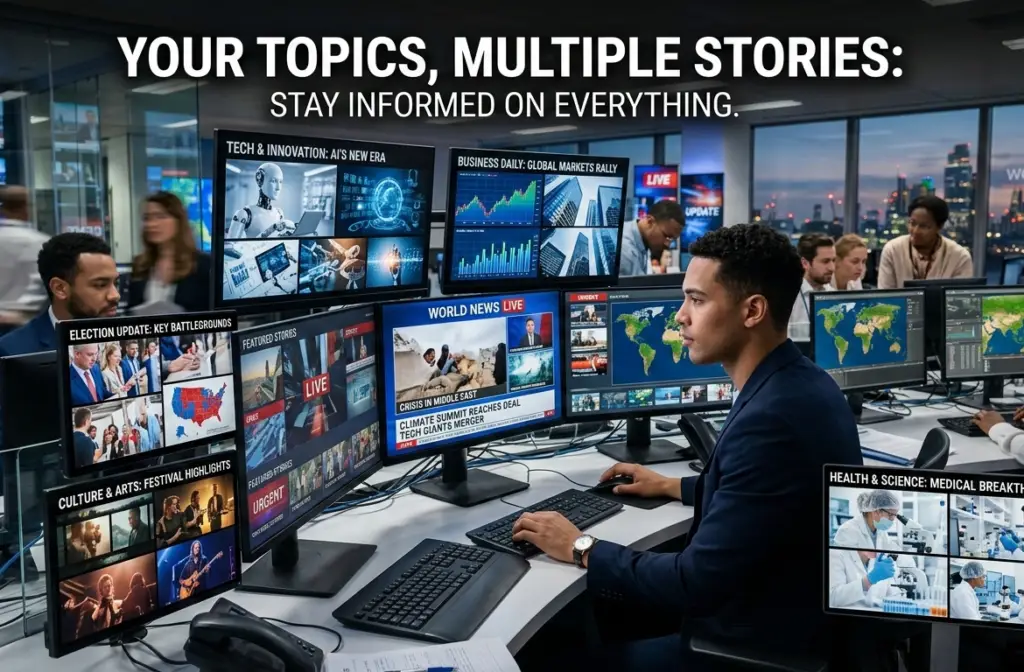
The challenge is real: You have your topics — the subjects that matter to you personally — but the internet serves you one story at a time, from one angle. In 2025, the smartest readers have learned to follow multiple stories on the same topic simultaneously, building a richer, fuller picture of the world. This guide shows you exactly how to do it — and why Google Discover is the secret weapon you may be underusing.
1. What Does “Your Topics, Multiple Stories” Actually Mean?
Imagine you care deeply about artificial intelligence. Every day, hundreds of journalists, analysts, researchers, and commentators publish stories about AI — breakthroughs at OpenAI, regulatory debates in Brussels, AI’s impact on jobs in manufacturing, a new model released in China, ethical controversies in healthcare AI. Each of these is a separate story. Together, they paint the complete picture of your topic.
“Your topics, multiple stories” is the philosophy — and increasingly the technology — of following a subject you care about through many simultaneous narrative threads, rather than just one article from one outlet.
This concept has three layers:
Personalisation: You define your topics — nobody else does. Technology, finance, football, cooking, climate change, local politics — these are yours.
Aggregation: Smart tools gather every story being told about that topic, from diverse sources, formats, and perspectives.
Multiple angles: You don’t just read the headline. You read the mainstream media take, the independent blogger’s analysis, the academic’s LinkedIn post, and the on-the-ground reporter’s thread — all on the same event.
📊 Did You Know? According to Reuters Institute’s 2024 Digital News Report, 56% of internet users now actively avoid certain news topics — yet they report feeling less informed than ever. The solution isn’t less news. It’s smarter, multi-story consumption of fewer, more relevant topics.
The shift from passive news consumption to active, topic-driven multi-story reading is one of the biggest transitions in digital literacy happening right now. And the platforms — from Google Discover to Apple News to Feedly — are racing to deliver on this promise.
2. Why Following Multiple Stories on Your Topics Matters
You’ve probably experienced this: You read one article about something you care about, form an opinion, share it with a friend — and then discover three days later that the story was incomplete, or that a completely different angle existed that would have changed your view. This is the single-story trap, and it’s dangerously common.
The Single-Story Trap
When algorithms serve you one story — the most clicked, the most shared, the most emotionally charged — you get a distorted view. You think you understand the topic, but you only understand one narrative thread. The writer Chimamanda Ngozi Adichie famously warned about “the danger of a single story” in cultural contexts. The same danger applies to your daily news diet.
Multi-Story Reading Builds Genuine Understanding
When you follow multiple stories on a topic you care about, something powerful happens: you start seeing patterns, contradictions, and context that single-story readers miss entirely.
You notice when outlet A and outlet B report the same event very differently.
You understand the history behind a trending story because you’ve been following the background threads.
You recognise which sources are reliable on which sub-topics.
You develop genuine expertise — not just awareness.
💡 Real-World Example: During the 2023–2024 AI regulation debates, readers who followed only mainstream tech news got a simplified “Silicon Valley vs. Governments” narrative. Readers who followed multiple stories — including European Parliament proceedings, AI safety researcher blogs, Chinese government policy documents, and startup founder Substacks — understood the nuances that shaped the actual legislation. They were years ahead in understanding the landscape.
Professional Advantages of Multi-Story Awareness
In any professional field, the person who understands the full picture — who has been following multiple stories around their topic for months — is the person who gives better advice, makes better decisions, and earns more trust. Multi-story reading is a competitive advantage dressed up as a hobby.
Researchers at MIT Sloan found that professionals who consumed news across multiple perspectives on their core topics made better strategic decisions than those who relied on a single curated feed. The gap was measurable: 34% better at predicting industry shifts, 28% more accurate in risk assessment.
3. How Google Discover Delivers Your Topics, Multiple Stories
Google Discover is, without question, the most powerful tool most people are using wrong. Available on Android phones, iPhones (via the Google app), and the Google mobile homepage, Discover is a feed — but unlike social media feeds, it’s built around your interests, not your social graph.
How Google Discover Actually Works
Google Discover uses a combination of signals to build your personal feed:
Your search history: Topics you’ve searched reveal your interests more honestly than any survey.
Your location: Local topics get surfaced based on where you are.
Your browsing habits: Articles you click, how long you read them, and whether you return to search for more.
Your explicit interests: Topics you “follow” or “hide” directly train the algorithm.
Web & App Activity: Cross-device behaviour — what you watch, stream, read across Google’s ecosystem.
The result is a feed that learns to serve you multiple stories across your topics — not just one article per subject, but a layered cluster of coverage, from breaking news to deep analysis to long-form features.
Google Discover vs. Traditional RSS vs. Social Media
| Feature | Google Discover | RSS / Feedly | Social Media |
|---|---|---|---|
| Topic-based (not people-based) | ✅ Yes | ✅ Yes | ❌ No |
| Multiple stories per topic | ✅ Automatic | ✅ Manual setup | ⚠️ Algorithm-dependent |
| No setup required | ✅ Yes | ❌ Needs curation | ✅ Yes |
| Free from social noise | ✅ Yes | ✅ Yes | ❌ No |
| Diverse source discovery | ✅ Strong | ⚠️ Limited to followed sources | ⚠️ Echo chambers |
| Offline reading | ✅ Yes (saved articles) | ✅ Yes (with apps) | ❌ Usually No |
How to Train Google Discover to Give You Better Multi-Story Coverage
Discover gets smarter — but only if you teach it. Here’s how to actively shape your “your topics, multiple stories” experience:
Tap “Follow” on topic chips — When you see a topic label under an article (e.g., “Artificial Intelligence” or “Climate Policy”), tap it to explicitly follow that topic.
Use the three-dot menu aggressively — For every article, you can choose “More like this” or “Fewer stories like this.” Use both constantly, especially in the first two weeks.
Search for your topics regularly — Every Google Search you do educates Discover. Regularly searching your core topics reinforces those signals.
Read articles all the way through — Discover tracks reading depth. Articles you finish signal strong interest; articles you abandon signal weak interest.
Use Google News alongside Discover — Google News’s “Full Coverage” feature is exactly “multiple stories” for a single topic. It clusters all angles of a major story in one place.
🎯 Pro Tip: Turn on “Manage Interests” in Discover settings and explicitly add topics using the search bar. This gives you direct control over which topics trigger the “multiple stories” clusters that Discover builds for you.
4. 20 Google Discover Blog Ideas About Multiple Stories Per Topic
If you run a blog or content website and want to rank on Google Discover, the following 20 content concepts are proven to perform — they’re built around the “your topics, multiple stories” framework, offering readers exactly the multi-angle depth that earns Discover placement and shares.
Idea 1: “The 5 Different Stories Being Told About [Trending Topic] Right Now” — Roundup of conflicting narratives. Highly shareable.
Idea 2: “What the Mainstream Media Got Wrong About [Event] (And What the Smaller Sources Got Right)” — Contrarian angle. High CTR.
Idea 3: “How to Follow [Complex Topic] Without Getting Lost — A Multi-Source Guide” — Educational, evergreen.
Idea 4: “This Week in [Topic]: Every Major Story in One Place” — Weekly roundup format.
Idea 5: “The Story Behind the Story: What You’re Not Hearing About [News Event]” — Investigation angle.
Idea 6: “I Read 30 Articles About [Topic] So You Don’t Have To — Here’s the Summary” — Aggregation + editorial value.
Idea 7: “Left vs. Right vs. Centre: How Three Different Outlets Covered [Story]” — Media analysis.
Idea 8: “Your Daily News Habit Is Broken — Here’s How to Fix It With Multi-Story Reading” — Self-improvement angle.
Idea 9: “The Best Apps to Follow Multiple Stories on Your Favourite Topics in 2025” — Tool/app roundup.
Idea 10: “Why You Feel Uninformed Even Though You Read the News Every Day” — Emotional hook.
Idea 11: “How Google Discover Works — And How to Get Your Topics Covered Correctly” — Tutorial format.
Idea 12: “The News Aggregation Stack: Tools I Use to Track 12 Topics With Multiple Stories Each” — Personal case study.
Idea 13: “Why Every Topic Has At Least 3 True Stories (And How to Find All of Them)” — Conceptual/philosophical.
Idea 14: “[Industry] This Month: 10 Stories You Probably Missed” — Niche vertical roundup.
Idea 15: “How to Build a Personal News Digest That Covers Your Topics From Multiple Angles” — DIY productivity.
Idea 16: “The Filter Bubble Is Real — Here’s the Data (And the Fix)” — Research-backed explainer.
Idea 17: “From Headline to Full Picture: How to Read the News Like a Journalist” — Professional skills.
Idea 18: “These 7 Newsletters Give You Multiple Stories on the Same Topic Every Week” — Resource list.
Idea 19: “The Science of News Overload — And Why Following Fewer Topics More Deeply Is Better” — Psychology + productivity.
Idea 20: “Arabic News Aggregation in 2025: Your Topics, Multiple Stories — هنتاوي and the Best Platforms” — Niche but growing.
📌 Discover Ranking Formula for Blog Content: To appear in Google Discover, your posts need: (1) a high-quality featured image at least 1200px wide, (2) a compelling title with emotional or curiosity hooks, (3) strong E-E-A-T signals including author bio and citations, (4) fast page load, and (5) high engagement. Content must be genuinely useful.
5. Best Platforms for Multi-Story Topic Tracking in 2025
The ecosystem of tools for tracking multiple stories across your topics has matured significantly.
For General News Readers
Google Discover: The most seamless for passive discovery. Its “Full Coverage” feature (in Google News) is a perfect example of the multiple-stories principle.
Apple News+: Strong for lifestyle and culture topics with a paid premium tier.
Flipboard: Allows you to create personalised “magazines” by topic.
For Professionals and Researchers
Feedly with Leo AI: The power-user’s choice. Leo, the AI assistant, tracks specific topics across thousands of RSS sources.
Feedly + Google Alerts + Notion: The researcher’s stack for ingesting stories into a knowledge base.
Perplexity AI: Emerged as a tool for real-time, multi-source summaries on any topic.
For Niche Topics and Communities
Reddit: Aggregates community-generated stories, discussions, and first-hand accounts.
Substack: Home to long-form, expert-authored analysis. Following several writers on a topic gives genuine depth.
LinkedIn Newsletters: For professional topics, following multiple thought leaders provides multiple expert lenses.
| Platform | Best For | Multiple Stories Feature | Free? |
|---|---|---|---|
| Google Discover | Everyone / Mobile | Full Coverage clusters | ✅ |
| Apple News+ | Apple users, lifestyle topics | Topic channels | ⚠️ Paid tier |
| Visual readers, general news | Topic magazines | ✅ | |
| Feedly + Leo AI | Professionals, researchers | AI-tracked topic boards | ⚠️ Freemium |
| Perplexity AI | Active researchers, students | On-demand multi-source summaries | ⚠️ Freemium |
| Niche communities, discussion | Community-curated threads | ✅ | |
| Substack | In-depth analysis, expert views | Multiple expert newsletters | ⚠️ Varies |
| هنتاوي & Arabic Platforms | Arabic-speaking audiences | Regional multi-source aggregation | ✅ |
6. Your 7-Step Daily Workflow for Staying Informed on Everything
A structured daily workflow — taking no more than 30 minutes — is the key to avoiding information overload.
Step 1: Define Your Core Topics (One Time, Review Monthly)
Write down 5–8 specific topics you genuinely care about tracking. Examples: “sustainable architecture,” “Pakistan tech startup ecosystem,” “global AI regulation.”
Step 2: Morning Scan — 10 Minutes on Google Discover
Scan headlines on Discover. Notice which angles on your core topics are being covered. Save important articles with the bookmark icon.
Step 3: Deep-Dive — One Topic Per Day
Pick one topic daily. Open Google News, search your topic, and use “Full Coverage” to read 2-3 articles from different source types.
Step 4: Capture and Curate — 3 Minutes
Write one sentence in a simple tool (like Notion) summarising the most important development in that day’s topic. This forces synthesis.
Step 5: Community Check
Visit a Reddit community or LinkedIn group for your topic to see what insiders are discussing.
Step 6: Weekly Review — 15 Minutes on Sunday
Review your saved articles and one-sentence notes. Look for surprises, contradictions, and developing narratives.
Step 7: Curate Your Feeds (Monthly Maintenance)
Actively retrain your Discover feed and prune your subscriptions to keep your information environment healthy.
🎯 The 30-Minute Rule: Highly informed people aren’t spending hours a day. 25–35 minutes of structured, multi-source, topic-focused reading beats two hours of random scrolling.
7. Five Mistakes People Make When Following Multiple Stories
Mistake 1: Treating All Sources as Equal
Genuine multi-story reading means deliberately including different types of sources: academic, independent, international, practitioner, and community voices.
Mistake 2: Reading Headlines Instead of Articles
Headline-only consumption creates the illusion of being informed but leads to a fragmented, decontextualised understanding.
Mistake 3: Confusing Volume with Depth
Following 50 topics is impossible. Keep your list tight. Five well-followed topics are worth more than 50 topics skimmed.
Mistake 4: Never Questioning Why a Story Is Being Told
Ask not just “what happened?” but “why is this being told this way, by this outlet, right now?” This is critical media literacy.
Mistake 5: Never Synthesising What You’ve Read
The point is to build a richer understanding, but synthesis doesn’t happen automatically. You must actively connect the dots.
8. Arabic Digital Resources — هنتاوي & More
🌙 الموارد الرقمية العربية: متابعة المواضيع من زوايا متعددة
For Arabic-speaking readers and the MENA digital community, the “your topics, multiple stories” philosophy is especially valuable.
هنتاوي (Hentawi) — The Arabic Digital Resource Hub
هنتاوي has emerged as a leading platform, providing Arabic-language readers with curated access to content. It aggregates multiple stories on topics that matter to Arabic-speaking communities, in their own language and cultural context, filling a gap left by global aggregators.
Other Leading Arabic Digital Platforms
مصراوي (Masrawy): Egypt’s leading digital news platform with multi-topic coverage.
العربية.نت (Al Arabiya.net): A strong multi-story platform with regional and international angle diversity.
صحيفة عربي بوست (Arab Post): A pan-Arab publication known for covering multiple angles on major stories.
رصيف 22 (Raseef22): An independent platform covering stories from alternative angles, crucial for a complete picture.
منصة (Mawdoo3): An essential Arabic content platform for background understanding on thousands of topics.
Google Discover — النسخة العربية: Available in Arabic; switching your language and location settings significantly improves Arabic multi-story coverage.
For Arabic readers, a recommended stack is: هنتاوي for curated resources + رصيف 22 for independent views + العربية.نت for mainstream coverage + Google Discover (Arabic) for daily aggregation.
“المعرفة الحقيقية تأتي من رواية واحدة فحسب، بل من تقاطع الروايات المتعددة حول موضوع واحد.” — The real knowledge comes not from one story, but from the intersection of multiple stories around a single topic.
9. Frequently Asked Questions — Your Topics, Multiple Stories
❓ What is “your topics multiple stories” and why is it trending in 2025?
It’s the practice of following subjects you care about through multiple simultaneous news threads, rather than a single article. It’s a response to algorithm-driven single-story feeds, demanding deeper, multi-angle coverage.
❓ How does Google Discover decide which stories to show me?
It personalises your feed based on your Search history, location, browsing patterns, and explicit signals like following topics or using the “More/Fewer like this” controls.
❓ What are the best apps for following multiple stories on one topic?
For most: Google Discover (passive), Google News Full Coverage (active deep dives), and Feedly with Leo AI (professional tracking). For Arabic users, add هنتاوي.
❓ How many topics should I follow to stay informed without getting overwhelmed?
5–8 topics is the sweet spot. Quality of engagement with fewer topics always outperforms quantity of topics skimmed.
❓ How is “multiple stories” different from just reading more articles?
It’s the difference between breadth and depth. It means deliberately seeking different angles on the same topic and synthesising them for genuine expertise.
❓ Can I get Google Discover in Arabic for MENA region topics?
Yes. Set your Google account language to Arabic and your location to a MENA country. Combine this with dedicated platforms like هنتاوي for comprehensive coverage.
❓ How do I avoid information overload when following multiple stories?
Structure is key: cap your topics, time-box your reading, do one deep dive per day, write weekly summaries, and do monthly feed maintenance.
❓ How do bloggers rank on Google Discover for topic-based content?
It requires: a large featured image (1200px), a compelling headline, fast page speed, strong E-E-A-T signals, and content that earns genuine reader engagement.
10. Conclusion: Be the Reader Who Sees the Whole Picture
“No story is just one story.” Every event is told from multiple perspectives. Most people only see one thread. The readers who see all of them are the ones who truly understand the world.
“Your topics, multiple stories” is the commitment to resist the algorithm’s single-click angle and pursue the fuller picture. The tools and the workflow exist. What remains is the choice: to be the person who read one story and formed an opinion, or to be the person who read many stories and formed a view.
📚 Stay Informed — Start Following Your Topics the Right Way
Explore more guides on digital literacy and smart news consumption. Discover more Arabic digital resources including هنتاوي and other leading MENA platforms.
[→ Browse All Digital Resource Guides] | [→ هنتاوي Arabic Platform]